
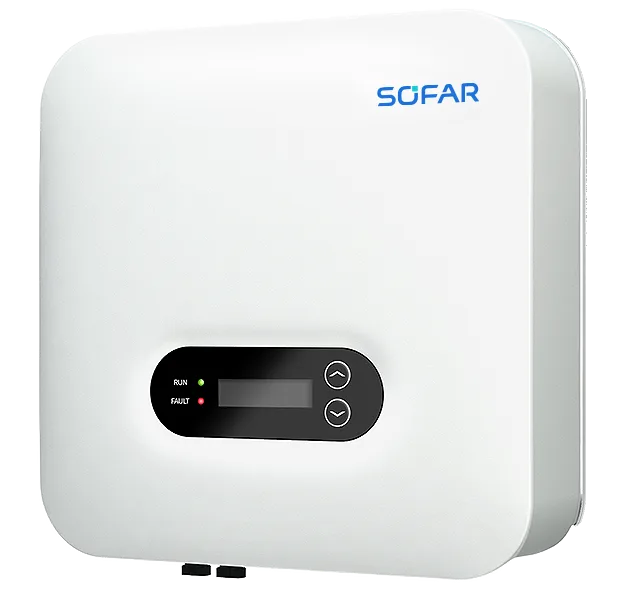

G3 Series 5KTLM-G3 (5kW Single-Phase)
- Type
- String Inverter
- Phases
- Single-phase
- Power
- 5kW
- Max AC output
- 5500 VA (5KTLM-G3) or 5000 VA (5KTLM-G3-A)
Warranty: 10 years
One Why Solar Approved installer, one written quote, and a 15-minute call with a solar expert before you sign.
By Bec Ramirez
The Sofar 5KTLM-G3 is a 5 kW single-phase string inverter with two MPPT inputs, made by Shenzhen SOFARSOLAR. It belongs to Sofar's 3K to 6KTLM-G3 range, which Sofar's Australian website still lists as a current residential inverter. In Australia it comes as the 5KTLM-G3 and a second variant, the 5KTLM-G3-A, and the two differ on Sofar's datasheet only in maximum apparent power.
Most people reading this have a quote that names a Sofar inverter and want to know what they are being offered. The facts that matter most are these. It is rated at 5000 W AC and takes up to 7500 Wp of panels, with a 98.4% maximum efficiency and an IP65 rating. Both model numbers are on the Clean Energy Council approved inverter list until 18 August 2027. Sofar's Australian terms give it a 10 year warranty, backed by Sofar's own Australian arm. It has no battery port, and its export limiting and Wi-Fi monitoring both rely on hardware that may not be in the box.
Every fact on this page was checked on 26 October 2026 against Sofar's own documents, the Clean Energy Council lists or a named publication, and the sources are listed at the end. Where Sofar's documents disagree with each other, we say so. Why Solar has not tested this inverter, and where a view comes from a reviewer we attribute it.
What the specifications mean
Sofar's Australian datasheet (version 4.2, dated 27 August 2024) gives the 5KTLM-G3 a rated output of 5000 W and 5000 VA at 230 V, single phase. The unit sold as the 5KTLM-G3 lists a maximum apparent power of 5500 VA and a maximum output current of 25 A. The 5KTLM-G3-A, which the Clean Energy Council lists beside it, is limited to 5000 VA and 21.7 A. Everything else on the datasheet is the same for the two. Sofar does not say why the -A variant exists, so ask your installer which model number is on your quote and which one your network application names.
Maximum efficiency is 98.4% and European efficiency is 97.5%. These are the manufacturer's own figures and the datasheet does not describe how they were measured, so use them to compare datasheets, not to predict your yield. The inverter is IP65 rated, cooled by natural convection with no fan, and listed for ambient temperatures from minus 30 to 60 degrees Celsius. Sofar's manual gives the noise level as under 25 dB. It measures 349 by 344 by 164 mm, weighs 10 kg and is transformerless.
The datasheet lists a DC switch, and the Clean Energy Council entry describes an inbuilt PV isolator. Sofar's user manual, however, lists the DC switch and arc fault protection (AFCI) as optional, and the Australian datasheet does not mention arc fault protection at all. Confirm what is fitted to the unit on your quote. The warranty also excludes damage from insufficient ventilation, so where it is mounted matters.
Solar input, MPPTs and panel count
There are two MPPTs with one DC input each. The datasheet gives an operating range of 80 to 550 V, a start-up voltage of 90 V, a maximum input voltage of 600 V and a maximum current of 15 A per MPPT (22.5 A short circuit). Sofar recommends no more than 7500 Wp of panels, which its datasheet describes as 150% DC overload. Sofar's global datasheet puts the limit for a single MPPT at 3750 W. For scale, 17 panels of 440 W add up to 7.48 kW.
Two MPPTs let you run two roof faces with different orientations as separate strings. The manual lets the installer set the inputs to run independently, which is the default, or in parallel. If the whole array sits on one roof face, one input may go unused. Our guides on oversizing a solar system and microinverters versus string inverters cover how to choose, and the 5 kW system price guide covers what a system of this size costs.
The Clean Energy Council entry lists only a grid port and a PV port for this inverter, so there is no battery connection. Adding a battery later means an AC-coupled battery that works with your setup, or a change of inverter. See adding a battery to existing solar before you decide.
Monitoring, Wi-Fi and the Solarman app
Sofar's user manual (October 2024) says the inverter reports generation, alerts and status through a Wi-Fi or GPRS stick. The owner registers an account, binds the stick to it, and watches the system on the Solarman web portal or in the SolarMAN app for Android and iOS. The unit itself has an LCD screen and a Bluetooth app for local set-up. The Clean Energy Council lists three software clients for this model: the Solarman gateway and cloud, SOFAR Cloud, and the Catch Power Catch Solar Relay. Which platform you end up on depends on the stick and set-up your installer uses, so ask before you buy.
Sofar's own documents disagree on whether Wi-Fi is included. The general data table in the Australian datasheet lists RS485 and Wi-Fi. Its feature list, Sofar's global datasheet and the manual's parts list all call Wi-Fi optional. Get it in writing that the stick is on your quote. Sofar's Australian terms give the Wi-Fi dongle its own 24 month warranty.
We found no independent test of the app, and Why Solar has not tested it, so we make no claim on its quality.
Export limiting and network requirements
The 5KTLM-G3 has an export limit function, but it needs measuring hardware. Sofar's manual says generation and export limit control require an external measuring device: a CT clamp by default, or a smart meter plus CT. Both are supplied separately from the inverter, so check your quote includes them. The limit is set in the inverter menu as the anti-reflux function, with soft and hard control options. According to the manual, only installers and distributors can change the hard setting, through the Bluetooth app and with permission from Sofar. If the inverter loses contact with the meter, soft control holds output down without a fault, while with hard control on it goes into a fault state.
For Australia, the manual tells installers to choose the grid setting Australia A, B or C for AS/NZS 4777.2:2020 and to ask the local network operator which one applies. Once commissioning is done, the grid protection and power quality settings are locked, and changes go through Sofar's monitoring platform by authorised people. The inverter supports the demand response commands DRM0 and DRM5 to DRM8 through its logic port. The manual also states that it has not been tested to AS/NZS 4777.2:2020 for multiple inverter combinations and cannot be used in multiple combinations, so two of them on one site is not something the manual supports.
Many networks now ask for CSIP-AUS, the protocol they use to communicate with inverters through a software client. The Clean Energy Council's table lists the 5KTLM-G3 with the SOFAR Cloud client tested by the Australian National University on 13 January 2026 against SA TS 5573:2025, which the Council says corresponds to CSIP-AUS v1.2, and it marks that listing as needing external accessories. The Solarman gateway and Catch Power relay entries are tested to the older v1.1a. Which version your network wants, and whether a listing is enough for your connection, is for the network and your installer to confirm. Our guide to solar export limits by state sets out what each network applies, and the NSW backstop explainer covers the NSW rules.
CEC listing, and whether it is still current
The Clean Energy Council approved inverter list includes both SOFAR 5KTLM-G3 (AS4777-2 2020) and SOFAR 5KTLM-G3-A (AS4777-2 2020), under certificate EESS-240831-0. We searched the list on 26 October 2026. Both are listed as single-phase, 5000 W grid connect inverters, approved from 18 August 2024, with an expiry date of 18 August 2027. The list is the check that matters for small-scale technology certificates, so make sure your quote names one of these exact model numbers. Our CEC approved products checker lets you look up a model yourself.
Sofar's Australian site lists the 3-6KTLM-G3 range among its residential PV inverters as at 26 October 2026, and the datasheet is the August 2024 edition. We found no discontinuation notice and no announced replacement. We have not seen distributor stock, so this says the range is current, not that every distributor holds it. The expiry date is worth keeping in mind if your install is planned for after August 2027.
We found no recall or safety notice for the 5KTLM-G3 on the Clean Energy Council recalls page. We could not search the ACCC Product Safety register directly, so this is not a check of that register. The recalls page does carry an entry dated 19 April 2018 for a voluntary recall of Sofar (Mass Energy) inverters supplied by Fortends Pty Ltd. The notice says those inverters could exceed voltage limits and might not switch off when required, and it applies to certain serial number patterns. It does not name the KTLM-G3, and we could not find an ACCC notice number for it.
Warranty and who backs it in Australia
Sofar's Australian terms, printed in the October 2024 user manual, give the inverter a standard 120 month (10 year) warranty. The CT clamp, smart meter and Wi-Fi dongle are covered for 24 months. Remedies are repair, on-site or off-site, or replacement, and a replacement carries the remaining warranty period. The warranty covers labour, materials and one freight to the owner, but not travel, accommodation or consequential loss. Claims go through your installer or dealer, or directly to Sofar's service line or its online warranty claim website, and need the model, the serial number and a copy of the purchase invoice.
Sofar has its own Australian arm. The manual names Sofarsolar Ausco Pty Ltd as the after-sales contact (1300 176 327, service@sofarsolar.com.au), and Sofar's Australian contact page lists a Sydney office at Suite 1903, 109 Pitt Street. An earlier version of the terms, version 1.1, is also in circulation. It gives 126 months from production if you cannot show an invoice, and it subjects claims to Chinese law, with arbitration in Shenzhen, a clause we did not find in the October 2024 text. Both versions say Australian Consumer Law guarantees cannot be excluded. Ask your installer which version applies to your serial number.
The manual's exclusions are worth reading before you choose where to mount it. They include insufficient ventilation, an unauthorised or unlicensed installer, lightning, overvoltage and grid surges, pests, and exposure to sea coasts, saltwater or other aggressive atmospheres. An extension to 10, 15 or 20 years can be bought from Sofar within 24 months of the production date. The manual does not say when the 10 years start. The earlier version starts them at the purchase date with a valid invoice, so keep yours.
What reviewers say about Sofar
We found no independent review of the 5KTLM-G3 itself, and no failure rate or market share figures we could source, so we make no claim on either.
If a quote names a Sofar inverter, the practical questions are which exact model, whether the Wi-Fi stick, CT and meter are included, which monitoring platform you will be on, who your installer will call if it faults, and which version of the warranty terms applies. Our solar inverter comparison puts other brands alongside, and the inverter cost guide covers price. We found no verified Australian price for the 5KTLM-G3 itself, so this page does not quote one.
All specifications
- Type
- String Inverter
- Phases
- Single-phase
- Power
- 5kW
- Max AC output
- 5500 VA (5KTLM-G3) or 5000 VA (5KTLM-G3-A)
- Max DC input
- 7500 Wp recommended, 600 V max, 15 A per MPPT
- MPPT trackers
- 2 (one DC input each)
- Efficiency
- 98.4% max, 97.5% European
- IP rating
- IP65
- Dimensions (mm)
- 349 x 344 x 164 (W x H x D)
- Weight
- 10 kg
Who it suits
A good fit
- You have a single-phase home and a roof of up to about 7.5 kWp of panels, on one or two roof faces.
- Your quote names the SOFAR 5KTLM-G3 or the 5KTLM-G3-A and you want to check its ratings, listing and warranty before you sign.
- You want an inverter on the Clean Energy Council list, with a 10 year warranty and a local Australian service line, and you do not plan to put a battery on the same inverter.
- You are happy to monitor through the Solarman platform or SOFAR Cloud, and to use a CT clamp or meter for export limiting.
Look elsewhere if
- Your home has a three-phase supply. The 5KTLM-G3 is single-phase.
- You want a battery on the same inverter. The Clean Energy Council entry lists only grid and PV ports.
- You want two of these inverters on one site. Sofar's manual says it has not been tested for multiple inverter combinations.
- You want per panel monitoring or shade handling, which is what microinverters are for.
Alternatives to compare
- Sofar 10KTLX-G3 three-phase inverter
Sofar's three-phase string range, which its Australian site lists as 3.3 to 12 kW with two MPPTs and up to 98.5% maximum efficiency. It is for homes on a three-phase supply. The 5KTLM-G3 is single-phase.
- Sofar HYD 5000-EP single-phase hybrid
The single-phase hybrid route if you want a battery on the same inverter. The 5KTLM-G3 has only PV and grid ports. Check the exact hybrid model against the Clean Energy Council list before relying on it.
- Sungrow SG5.0RS
Another 5 kW single-phase string inverter with two MPPTs. Its datasheet lists 97.9% maximum efficiency against Sofar's 98.4%, 16 A per input against 15 A, and an integrated arc fault circuit interrupter, which the Sofar Australian datasheet does not list. Datasheet maximums are not a yield comparison, so compare warranty terms and local support on each quote.
Common questions
What are the specifications of the Sofar 5KTLM-G3?
Sofar's Australian datasheet (version 4.2, 27 August 2024) gives a rated output of 5000 W and 5000 VA at 230 V single phase, with two MPPTs, an operating range of 80 to 550 V, up to 7500 Wp of panels and 15 A per MPPT. Maximum efficiency is 98.4% and European efficiency is 97.5%. It is IP65 rated, uses natural cooling, measures 349 by 344 by 164 mm and weighs 10 kg.
What is the difference between the 5KTLM-G3 and the 5KTLM-G3-A?
On Sofar's Australian datasheet the only differences are maximum apparent power (5500 VA for the 5KTLM-G3 and 5000 VA for the 5KTLM-G3-A) and maximum output current (25 A and 21.7 A). Both are on the Clean Energy Council list. Sofar does not explain why the -A exists, so ask your installer which one is on your quote.
Is the Sofar 5KTLM-G3 on the CEC approved inverter list?
Yes. Both SOFAR 5KTLM-G3 (AS4777-2 2020) and SOFAR 5KTLM-G3-A (AS4777-2 2020) are listed under certificate EESS-240831-0, approved from 18 August 2024 with an expiry date of 18 August 2027 (checked 26 October 2026). Make sure your quote names one of those exact model numbers.
What warranty does the Sofar 5KTLM-G3 have in Australia?
Sofar's Australian terms give the inverter 120 months (10 years), and the CT clamp, smart meter and Wi-Fi dongle 24 months. Claims go through your installer or dealer or directly to Sofar Australia on 1300 176 327. An earlier version of the terms started the 10 years at the purchase date with a valid invoice, so keep it. An extension to 10, 15 or 20 years can be bought within 24 months of the production date.
Does the Sofar 5KTLM-G3 have Wi-Fi, and which app does it use?
Monitoring runs through a Wi-Fi or GPRS stick, which Sofar's manual and global datasheet call optional, while the communication row of the Australian datasheet lists RS485 and Wi-Fi. Confirm the stick is on your quote. The manual points owners to the Solarman web portal and the SolarMAN app, and the Clean Energy Council also lists SOFAR Cloud and the Catch Power Catch Solar Relay as software clients for this model.
Can the Sofar 5KTLM-G3 limit exports to the grid?
Yes, with extra hardware. The inverter has an export limit function, and Sofar's manual says it needs an external CT clamp or a smart meter plus CT, supplied separately. The limit is set by the installer in the inverter menu. What limit applies depends on your network, so check your connection approval.
Is the Sofar 5KTLM-G3 still current or has it been discontinued?
Sofar's Australian website listed the 3-6KTLM-G3 range among its residential PV inverters on 26 October 2026, and the datasheet is the August 2024 edition. We found no discontinuation notice and no announced replacement. We have not seen distributor stock levels.
Can I add a battery to a Sofar 5KTLM-G3?
Not to the inverter itself. The Clean Energy Council entry lists only a grid port and a PV port, so there is no battery connection. A battery would need to be AC-coupled and compatible with your system, or the inverter would need to be swapped for a hybrid model.
Is Sofar a reliable inverter brand, and has it been recalled?
We cannot give a reliability rating because we found no failure rate data we could source. A 2018 voluntary recall of Sofar (Mass Energy) inverters supplied by Fortends Pty Ltd appears on the Clean Energy Council recalls page. It does not name the KTLM-G3, and we found no recall for the 5KTLM-G3.
Sources
- Clean Energy Council approved inverter list, searched through the Council's own search on the page, checked 26 October 2026.
- Clean Energy Council CSIP-AUS software client table for approved inverters, checked 26 October 2026.
- Sofar, 3K~6KTLM-G3 Australian datasheet, version 4.2 of 27 August 2024 (hosted copy on Solar Proof), checked 26 October 2026.
- Sofar, 3K~6KTLM-G3 user manual (October 2024, includes the Australian warranty terms), checked 26 October 2026.
- Sofar, 3K~6KTLM-G3 global datasheet (upload dated January 2023), checked 26 October 2026.
- Sofar Australia, residential PV inverter range, checked 26 October 2026.
- Sofar Australia, 3.3-12KTLX-G3 three-phase inverter page, checked 26 October 2026.
- Sofar Australia, contact page, checked 26 October 2026.
- Sofar, Australian warranty terms and conditions, version 1.1 (copy hosted by Solar Proof, printed July 2025), checked 26 October 2026.
- Clean Energy Council product recalls page (2018 Sofar recall entry), checked 26 October 2026.
- Sungrow, SG5.0/6.0RS datasheet, version 12 (hosted copy on Sparky Direct), checked 26 October 2026.