Commercial Solar for Business

Cut your operating costs with solar on the roof you already have, from a 30kW system on a shop to multi-megawatt sites. We match you with one SAA-accredited commercial installer for a written quote.

Typical payback
2 to 5years
System lifespan
25+years
Cost under 100kW
~$1/W
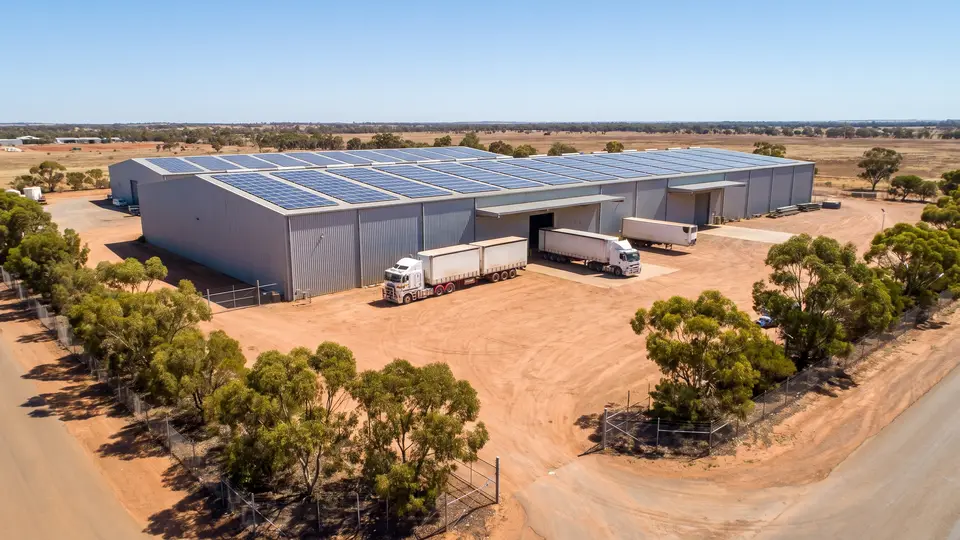
Aerial view of a large rural warehouse with solar panels across its roof and semi-trailers at the loading dock

Why commercial solar makes business sense

The case is mostly financial. A business uses most of its power during the day, while the panels are producing, so far more of the output is used on site than at a home.
  1. Lower operating costs

    Lock in low electricity costs for 25+ years. A typical payback of 2 to 5 years leaves decades of savings.

  2. Tax incentives

    Immediate asset write-off for eligible businesses. Accelerated depreciation can significantly reduce tax liability.

  3. Sustainability goals

    Meet ESG targets and reduce your carbon footprint, with a figure you can report to customers.

  4. Energy security

    Protect against rising electricity prices. Generate your own power during business hours when you need it most.

  5. Property value

    Solar installations increase commercial property value and appeal to tenants who care about running costs and emissions.

  6. Power purchase agreements

    No upfront cost options are available. A PPA lets you buy solar power at fixed rates below grid prices.

How our service works

Why Solar is free for your business. The installer pays us a set fee for the introduction, not a commission on the system.
  1. Free business case analysis

    Share your electricity bills and site details. We look at your consumption pattern, roof space and likely savings.

  2. One written quote

    We match you with one SAA-accredited commercial installer, who quotes from your bills and the site.

  3. Help reading it

    Ask us what a line in the quote means, how a finance offer compares with paying cash, and which certificates apply. No pressure, just advice.

  4. Installation

    The installer handles design, network approval, installation and commissioning.

Why one installer, not five. Five proposals built on five sets of assumptions are hard to compare. Every installer we match is SAA-accredited and commercially insured, with business installations behind them, so you get one quote you can check line by line.

Commercial system sizes

A commercial system is sized to your energy use, roof space and business hours. This is a guide to the typical sizes.
  • 30kW

    ~$30,000

    Small business, retail store, café

    Panels
    60 to 75
    Daily output
    120kWh
    Payback
    3 to 4 years
  • 50kW

    ~$50,000

    Medium warehouse, office building

    Panels
    100 to 125
    Daily output
    200kWh
    Payback
    3 to 5 years
  • 100kW

    ~$100,000

    Large commercial, manufacturing

    Panels
    200 to 250
    Daily output
    400kWh
    Payback
    2 to 4 years
  • 250kW+

    Custom quote

    Industrial facility, large campus

    Panels
    500+
    Daily output
    1,000kWh+
    Payback
    2 to 4 years

*Prices after federal STC rebate (available for systems under 100kW, and under 1MW from 1 October 2026). Larger systems have different economics. Actual costs vary by location, roof complexity, and electrical upgrades required.

Commercial against residential solar

Commercial solar

Larger panels (72-cell)
More efficient for high energy demands
Three-phase power
Handles higher loads and larger inverters
Tax deductible
Immediate write-off available for eligible businesses
Daytime usage match
Businesses use power while the sun shines (9am to 5pm)
Faster payback
2 to 5 years typical, against 4 to 8 years for a home

Residential solar

Smaller panels (60-cell)
Easier to handle and install on residential roofs
Single-phase power
Standard for Australian homes
Federal STCs only
No tax benefits, but generous upfront rebates
Battery storage focus
Store excess for evening and night use
Feed-in tariffs
Export excess power to grid for credits

Commercial solar FAQs

How much does commercial solar cost?
Systems under 100kW average around $1 per watt after STCs. A 50kW system costs approximately $50,000 installed. Systems over 100kW miss the upfront STC discount until 1 October 2026, when the scheme expands to cover everything up to 1MW. We match you with one vetted commercial installer for a free, no-obligation quote.
What tax benefits are available for businesses?
Businesses can claim immediate asset write-off for solar installations (subject to eligibility). The system can be fully depreciated in the year of installation, significantly reducing taxable income. Consult your accountant for specific benefits based on your business structure and revenue.
How long is the payback period?
Typical payback periods range from 2 to 5 years depending on your electricity rates, usage patterns, and system size. Businesses with high daytime energy consumption see faster payback. Our business case analysis calculates your specific payback period.
Do we need to own the building?
Not necessarily. Many businesses install solar through Power Purchase Agreements (PPAs) where a third party owns the system. You simply buy the solar power at agreed rates. Landlords can also install systems and pass savings to tenants. We can explain all options.
What size system do we need?
This depends on your energy consumption, roof space, and goals. We analyse your electricity bills to recommend the right size. Most businesses install systems to cover 80 to 100% of daytime usage. Oversizing isn't usually cost-effective due to low feed-in tariffs.
Can we add battery storage?
Yes. Commercial batteries make sense if you have evening or night loads or want backup power. Battery economics are improving, especially with VPP programs that provide extra revenue. Ask for battery options to be included in your quote.
How is commercial solar different from residential?
Commercial systems use larger 72-cell panels (against 60-cell residential), three-phase power, and commercial-grade inverters. Installation complexity is higher due to building codes, structural engineering, and commercial electrical requirements. However, businesses typically see faster payback due to higher daytime usage and tax benefits.
What solar grants are available for businesses?
Australian businesses can access several incentives: federal STCs (Small-scale Technology Certificates) for systems under 100kW, a ceiling that rises to 1MW on 1 October 2026, instant asset write-off for tax deductions, and state-specific grants. NSW offers the Energy Savings Scheme, QLD has the Business Energy Saving and Transformation (BEST) program, and various local council grants may also be available. Contact us for a free assessment of all grants applicable to your business.
How much do commercial solar panels cost?
Commercial solar costs approximately $0.80 to $1.20 per watt installed, depending on system size and complexity. A 30kW system costs around $25,000 to $35,000, a 50kW system around $40,000 to $55,000, and a 100kW system around $80,000 to $110,000. Prices are before any applicable rebates or tax benefits. Larger systems often achieve better per-watt pricing.
Do we need network approval to install commercial solar?
Usually yes, and it is the most common cause of delay. Systems up to 30kW generally follow a straightforward connection process. Between 30kW and 100kW your electricity distributor (the DNSP, not your retailer) has to approve the connection and may impose an export limit or ask for a network study. Larger systems take longer again. Ask your installer to lodge the application early and to tell you what export limit they expect.
Can we get commercial solar with no upfront cost?
Often, yes. The common structures are a chattel mortgage, where you own the system and claim the depreciation, an operating lease, or a power purchase agreement where a third party owns the system on your roof and sells you the power at an agreed rate. Under a PPA you generally do not own the asset, so the instant asset write-off and the upfront certificate discount sit with the owner rather than with you. Why Solar does not provide finance. Ask your installer to quote the cash price alongside any finance option so you can see what the finance costs.
What happens to the power we do not use?
It is exported to the grid, but commercial feed-in rates are negotiated with your retailer rather than set by a standard tariff, and they usually sit well below what you pay for power. That is why commercial systems are sized to daytime usage rather than to available roof space. A system that self-consumes 80% of what it generates will almost always beat a larger one that exports half of it. Many networks also apply an export limit as a condition of connection.
Does a commercial solar system need maintenance?
Yes. Clean Energy Council guidelines set a maintenance schedule, and most commercial systems are inspected annually or every couple of years depending on size and site. Panels in dusty, coastal or industrial locations need cleaning more often than suburban rooftops, where rain does most of the work. Budget for it: a system quietly underperforming for two years costs more than the inspection would have.
Will a battery keep us running in a blackout?
Only if it is specified that way. A standard grid-connected battery shuts down during an outage along with the solar, to protect anyone working on the network. Backup requires a separate protected circuit and usually a different inverter, and it typically covers essential loads rather than the whole site. If keeping refrigeration, tills or servers running matters, say so before the quote is written.

Find out what solar would save your business

Send us your bills and site details. We run a free business case and match you with one SAA-accredited commercial installer for a written quote. No obligation.

Up to $8,000+ in solar and battery rebates · Federal rebates step down in 80 daysSee how we calculate this