
Heat Pump Hot Water Systems
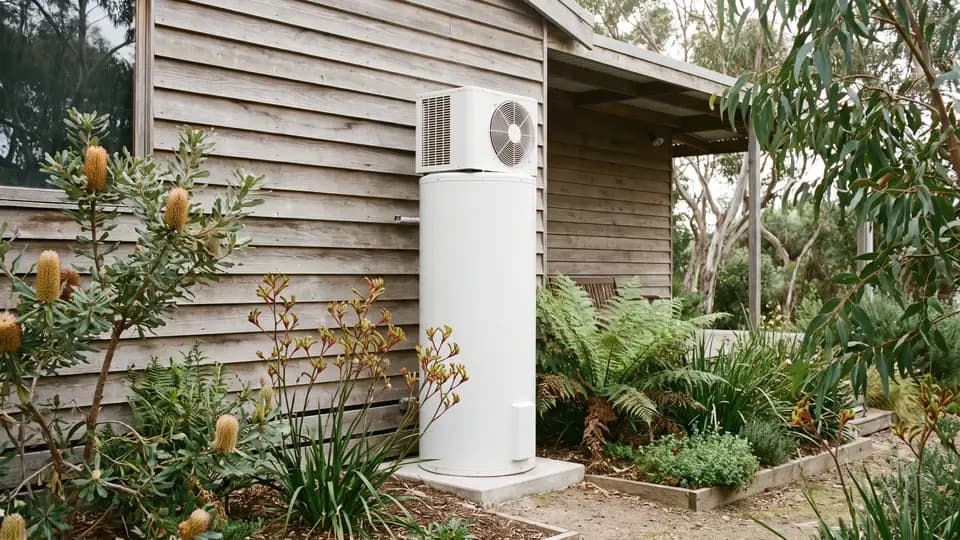
The usual replacement for gas and electric hot water. A heat pump uses up to 75% less energy than an electric tank, can run on your own rooftop solar, and can qualify for up to $2,600 in stacked federal and state rebates.
- Less energy
- 75%
- Annual savings
- $400+
- Maximum rebates
- $2,600
- Gas needed
- 0
Prices, specs and rebates as at February 2026.
Hot water system comparison
Heat pumpMost efficient
- Efficiency
- 300 to 400%
- Running cost a year
- $150 to $250
- Upfront cost
- $3,500 to $5,500
- Lifespan
- 10 to 15 years
- Emissions
- Lowest (with solar)
Electric storage
- Efficiency
- 90 to 95%
- Running cost a year
- $500 to $800
- Upfront cost
- $1,500 to $2,500
- Lifespan
- 10 to 15 years
- Emissions
- High
Gas storage
- Efficiency
- 70 to 80%
- Running cost a year
- $400 to $600
- Upfront cost
- $1,800 to $2,800
- Lifespan
- 10 to 12 years
- Emissions
- High
Solar thermal
- Efficiency
- 60 to 80%
- Running cost a year
- $100 to $200
- Upfront cost
- $4,000 to $7,000
- Lifespan
- 15 to 20 years
- Emissions
- Very low
How heat pump hot water works
Extract
A fan draws outside air across an evaporator that holds the refrigerant.
Compress
The compressor raises the refrigerant’s temperature to 60 to 80°C.
Transfer
The hot refrigerant passes its heat to the water through a heat exchanger.
Store
The hot water sits in an insulated tank, ready when you need it.
4 kWh
of heat from 1 kWh of electricity, at a COP of 4.0
COP rating explained
COP (coefficient of performance) measures efficiency. A COP of 4.0 means every 1kWh of electricity the system uses produces 4kWh of heat. A traditional electric water heater has a COP of about 0.9. The best heat pumps reach 5.0 and above.
Heat pump vs gas hot water
Annual running cost
- Heat pump
- $150 to $250
- Gas storage
- $400 to $600
- Gas instantaneous
- $350 to $550
Efficiency
- Heat pump
- 300 to 400% (COP 3 to 4)
- Gas storage
- 60 to 70%
- Gas instantaneous
- 80 to 85%
Annual CO2 emissions
- Heat pump
- About 0.5t (less with solar)
- Gas storage
- About 2.0t
- Gas instantaneous
- About 1.5t
Upfront cost (installed)
- Heat pump
- $3,500 to $5,500
- Gas storage
- $1,800 to $2,800
- Gas instantaneous
- $2,000 to $3,500
After rebates
- Heat pump
- $2,000 to $4,000
- Gas storage
- No rebates
- Gas instantaneous
- No rebates
Works with solar PV
- Heat pump
- Yes
- Gas storage
- No
- Gas instantaneous
- No
Gas connection needed
- Heat pump
- No
- Gas storage
- Yes
- Gas instantaneous
- Yes
Lifespan
- Heat pump
- 10 to 15 years
- Gas storage
- 10 to 12 years
- Gas instantaneous
- 15 to 20 years
With gas prices rising 10 to 15% a year in most states and no rebates for gas systems, switching to a heat pump typically pays for itself in 3 to 5 years. Many states are also phasing out new gas connections in new builds.
Heat pump vs solar hot water systems
Heat pump hot water
- Works day and night, in any weather
- No roof panels needed
- 300 to 400% efficiency (COP 3 to 4)
- Lower upfront cost ($3,500 to $5,500)
- Minimal maintenance
- Eligible for all rebates
Solar thermal hot water
- Drawback: Only works in sunny periods
- Drawback: Needs a suitable north-facing roof
- Drawback: 60 to 80% efficiency
- Drawback: Higher upfront cost ($4,000 to $7,000)
- Drawback: Roof panels need periodic cleaning
- Advantage: Very low running costs when it is sunny
Why the industry has shifted to heat pumps. Solar thermal systems were popular through the 2000s and 2010s, but heat pumps have improved a great deal since. A modern heat pump is more efficient, works in all conditions and costs less to install, and with the rebates it is better value for most Australian homes. If you have rooftop solar panels, a heat pump that runs during the day gives you "solar hot water" without the drawbacks.
Split system vs integrated (all-in-one) heat pumps
Split system
The compressor sits outdoors and the storage tank is installed separately (often indoors or somewhere else), connected by refrigerant lines.
Good
- Quieter (the compressor is outside)
- Generally higher COP ratings
- The tank can go somewhere sheltered
- Better cold climate performance
Watch for
- Higher upfront cost ($4,000 to $5,500)
- More complex installation
Popular split models: Reclaim Energy, Sanden Eco Plus, Hydrotherm Dynamic X8
Integrated (all-in-one)
The compressor sits on top of, or is built into, the storage tank as a single unit. A simpler design with fewer installation variables.
Good
- Lower upfront cost ($3,000 to $4,200)
- Simpler, faster installation
- One footprint, less space needed
- Easier to retrofit into an existing setup
Watch for
- Generally noisier (the whole unit is outdoors)
- Slightly lower efficiency
Popular integrated models: iStore, Rheem Ambiheat, EvoHeat DHWS
CO2 vs R290 refrigerant: which is better?
GWP (global warming potential)
- CO2 (R744)
- 1
- R290 (propane)
- 3
- R134a (older)
- 1,430
Ozone depletion
- CO2 (R744)
- Zero
- R290 (propane)
- Zero
- R134a (older)
- Zero
Cold climate performance
- CO2 (R744)
- Excellent (to -10°C and below)
- R290 (propane)
- Good (to -7°C)
- R134a (older)
- Fair (to -5°C)
Typical COP range
- CO2 (R744)
- 4.0 to 5.2
- R290 (propane)
- 3.5 to 4.5
- R134a (older)
- 3.0 to 4.0
Flammability
- CO2 (R744)
- Non-flammable
- R290 (propane)
- Mildly flammable
- R134a (older)
- Non-flammable
Upfront cost
- CO2 (R744)
- Higher ($4,000 to $5,500)
- R290 (propane)
- Moderate ($3,500 to $4,500)
- R134a (older)
- Lower ($3,000 to $4,000)
Example brands
- CO2 (R744)
- Reclaim, Sanden
- R290 (propane)
- Hydrotherm, EvoHeat
- R134a (older)
- iStore, Rheem
For cold climates (southern Victoria, Tasmania, the ACT and the highlands), CO2 heat pumps are the clear winner. Where the climate is milder and budget comes first, R290 models are very efficient at a lower price. Both are big upgrades on older R134a systems.
Best heat pump hot water brands in Australia, 2026

Reclaim Energy
Australian
Top pick: efficiency
- COP rating
- Up to 5.2
- Capacity
- 270L, 315L
- Refrigerant
- CO2 (R744)
- Type
- Split
- Noise
- 37 dB
- Warranty
- 6 years (15yr tank)
- CO2 refrigerant
- Works to -10°C
- Quiet 37 dB operation
- STC eligible
Premium Australian-designed system with industry-leading efficiency. Top pick for cold climates.

Sanden Eco Plus
Japan
- COP rating
- Up to 5.0
- Capacity
- 160L, 250L, 315L
- Refrigerant
- CO2 (R744)
- Type
- Split
- Noise
- 38 dB
- Warranty
- 6 years (15yr tank)
- CO2 refrigerant
- Stainless steel tank
- Split system design
- Low 38 dB noise
Japanese engineering with excellent long-term reliability. 15-year tank warranty is best in class.

Hydrotherm Dynamic X8
Australian
- COP rating
- Up to 4.5
- Capacity
- 280L
- Refrigerant
- R290 (Propane)
- Type
- Split
- Noise
- 42 dB
- Warranty
- 6 years
- R290 refrigerant
- 4.8/5 ProductReview
- Smart Wi-Fi control
- STC eligible
4.8/5 on ProductReview. Australian-designed with strong installer feedback and smart features.

EvoHeat DHWS
Australian
- COP rating
- Up to 4.2
- Capacity
- 270L, 315L
- Refrigerant
- R290 (Propane)
- Type
- Integrated
- Noise
- 45 dB
- Warranty
- 5 years
- R290 refrigerant
- 4.8/5 ProductReview
- Touch panel controls
- Budget friendly
4.8/5 on ProductReview and widely rated as a top overall pick. Great value integrated unit.

iStore
Australian
- COP rating
- Up to 4.0
- Capacity
- 180L, 270L
- Refrigerant
- R134a
- Type
- Integrated
- Noise
- 48 dB
- Warranty
- 5 years
- Integrated design
- Smart timer controls
- Easy installation
- Affordable price
One of Australia's most popular heat pumps. Simple all-in-one design at a competitive price.

Rheem Ambiheat
Australia
- COP rating
- Up to 3.8
- Capacity
- 270L, 325L
- Refrigerant
- R134a
- Type
- Integrated
- Noise
- 52 dB
- Warranty
- 5 years
- Established brand
- Nationwide service network
- Boosted heating mode
- WiFi optional
Trusted brand with the largest service network in Australia. Easy to get parts and repairs.
Heat pump noise levels compared
Reclaim Energy CO2
Whisper / library
37 dB
Sanden Eco Plus
Whisper / library
38 dB
Hydrotherm Dynamic X8
Quiet conversation
42 dB
EvoHeat DHWS
Refrigerator hum
45 dB
iStore
Moderate rainfall
48 dB
Rheem Ambiheat
Quiet suburb street
52 dB
Air conditioner (outdoor)
For reference
55 to 60 dB
Most councils require outdoor equipment to stay below 45 dB at the property boundary. For units above that, placing the heat pump away from bedroom windows and neighbouring fences, and fitting anti-vibration mounts, will usually bring the noise within limits.
Heat pumps and solar: hot water at close to zero cost
Heat pumps pair well with solar power. Run yours while the panels are generating and it heats the water with surplus solar you would otherwise export at low feed-in tariff rates.
Smart timing
Set the heat pump to run in the middle of the solar day (10am to 2pm) so it uses as much of your own power as it can.
Reduce export
Use excess solar to heat water instead of exporting it at low feed-in rates. More on solar export limits.
Lower bills
Many households cut another $300 to $500 a year off their electricity bill this way.
- 11:00am
Solar peak
Heat pump starts, drawing 1.5kW
- 12:30pm
Heating complete
Tank at 60°C, about 2.25kWh of solar used
- 6:00pm
Evening shower
Hot water ready, no grid power used
ESS, VEU and REPS stack on top of federal STCs
VEU, Victoria
Victorian Energy Upgrades
Victoria's energy efficiency scheme provides VEECs (certificates) that take a large slice off the cost of a heat pump.
- State rebate
- $800 to $1,200
- Plus federal STCs
- $700 to $1,400
- Total savings
- $1,500 to $2,600
ESS, NSW
Energy Savings Scheme
NSW retailers provide ESCs (certificates) when you upgrade to an efficient heat pump hot water system.
- State rebate
- $600 to $1,200
- Plus federal STCs
- $700 to $1,400
- Total savings
- $1,300 to $2,600
REPS, South Australia
Retailer Energy Productivity Scheme
SA energy retailers offer REPS incentives for installing eligible heat pump hot water systems.
- State rebate
- $500 to $1,000
- Plus federal STCs
- $700 to $1,400
- Total savings
- $1,200 to $2,400
How rebate stacking works
Federal STCs (all states)
Small-scale Technology Certificates are created when you install an eligible heat pump. How many you get depends on your location (zone) and the system's efficiency. Your installer claims them and takes them off your upfront cost.
State schemes (VIC, NSW, SA)
VEU, ESS and REPS are retailer obligation schemes. Energy retailers must surrender certificates, which creates demand. When you upgrade, you can assign your certificates to a provider for an upfront discount, separate from the STCs.
A licensed local installer prices it with the rebates taken off.
Heat pump rebates by state
- Federal$700 to $1,400STCs based on zone and old system type
- VIC$1,000+VEU certificates plus the Hot Water RebateStacks with STCs
- NSW$600 to $1,200ESS certificates from retailersStacks with STCs
- SA$500 to $1,000REPS certificates from retailersStacks with STCs
- QLD$700 to $1,400Federal STCs only
Heat pump hot water: frequently asked questions
Are heat pumps better than solar hot water?
What is the difference between heat pump and solar hot water?
Should I replace my solar hot water with a heat pump?
How noisy are heat pump hot water systems?
Do heat pumps work in cold weather?
What size heat pump do I need?
Can I replace my gas hot water with a heat pump?
What is VEU/ESS/REPS rebate stacking?
What is the difference between a split system and integrated heat pump?
Is a CO2 or R290 refrigerant heat pump better?
How long does heat pump installation take?
Related resources
Heat pump costs
2026 prices by brand, capacity and installation type.
Installation guide
What to expect when a heat pump goes in.
Best solar batteries
Pair a battery with your heat pump to use more of your own solar.
Solar calculator
Work out your solar and heat pump savings.
Upgrade to heat pump hot water
Cut hot water running costs by up to 75% and stop paying for gas to heat it. Get a free quote from a licensed local installer, with every rebate you qualify for taken off.