
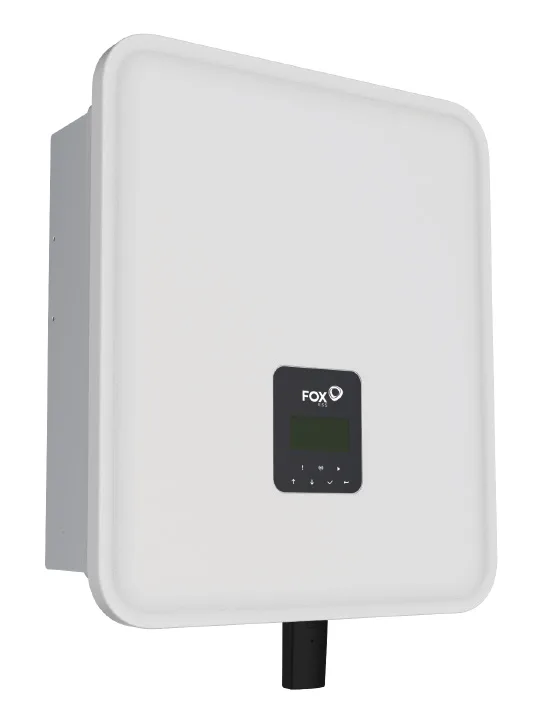

H3 Series H3-8.0 (8kW Three-Phase Hybrid)
- Type
- Hybrid Inverter
- Phases
- Three-phase
- Power
- 8kW
Warranty: 10 years
One Why Solar Approved installer, one written quote, and a 15-minute call with a solar expert before you sign.
By Bec Ramirez
The FoxESS H3-8.0 is an 8 kW three-phase hybrid inverter. Fox's Australian datasheet names it the H3-8.0-E and sets it in a line of six sizes from 5 to 12 kW. It has two MPPT solar inputs, takes a high-voltage lithium iron phosphate (LFP) battery between 180 and 600 V, and has a three-phase backup output rated at 8 kVA. Its rated output is 8,000 W and Fox quotes a maximum efficiency of 98.0%.
The fact to know first is that this is the original H3, not the H3 Smart. Fox's Australian hybrid inverter page now lists the H3 Smart, H3 PRO and H3 Plus and no plain H3. Fox's current inverter warranty policy names H3 Smart, H3 Pro and H3 Plus models but not the H3-E. And the H3-8.0-E does not appear on the Clean Energy Council approved inverter list, where all seven H3 Smart sizes do. We found no notice from Fox that the H3 is discontinued.
Most readers either have an H3-8.0 installed, hold a quote or second-hand listing that names one, or are comparing it with the H3 Smart. Below we set out the status, the specifications, battery pairings and backup, how it differs from the H3 Smart, what the CEC listing means for rebates, the warranty and recall position, and the other sizes in the line. Everything was checked on 26 October 2026. Where a figure comes from a trade publication or a retailer and not from Fox or a regulator, we say so.
Is the FoxESS H3 still current in Australia?
Fox's Australian hybrid inverter page lists the three-phase H3 Smart (5 to 15 kW), H3 PRO (15 to 30 kW) and H3 Plus (50 to 125 kW), plus the single-phase H1/AC1 and KH/KA ranges. There is no plain H3 or H3-E. The datasheet download centre has sheets for the H3 Smart, H3 PRO and H3 Plus and none for the H3. Fox's support site covers the H3 Smart and H3-Pro and does not mention the original H3.
The original sheet has not been pulled, though. The H3 and AC3 datasheet (version 1.1, dated 2 July 2025) is still hosted on Fox's Australian site, and so is Fox's inverter and battery configuration guide, which still has a column for the H3 and AC3. We found no statement from Fox that the H3 is discontinued or that the H3 Smart replaces it.
The H3 Smart is offered in the same output sizes (5, 6, 8, 9.9, 10 and 12 kW, plus 15 kW), so it is the nearest current model, but calling it a replacement is our reading, not Fox's. The practical point is the name on your quote. H3-8.0-E is the original. H3-8.0-Smart is the model on the CEC list.
FoxESS H3-8.0-E specifications
On the AC side the H3-8.0-E is rated at 8,000 W, with a maximum apparent output of 8,800 VA. Rated current is 11.6 A per phase and the maximum is 13.3 A per phase. The grid is three-phase, 400/230 V in Australia, at 50 or 60 Hz, with power factor adjustable from 0.8 leading to 0.8 lagging. Fox quotes a European efficiency of 97.3% and a maximum of 98.0%. For battery paths it gives 98.5% from solar to battery and 97.0% from battery to AC, both at full load.
On the solar side there are two MPPT trackers. Fox lists a maximum array of 16,000 Wp, twice the 8 kW rating, but input power is capped per tracker: 8,000 W on tracker A and 5,000 W on tracker B, so no more than 13 kW can enter the inverter as DC. Tracker A takes two strings at up to 26 A and tracker B takes one string at up to 14 A. The MPPT window is 160 to 950 V and the inverter starts at 160 V. Panels on different roof faces need to be divided across the two trackers with those limits in mind. Our guide on oversizing a solar system covers when a large array on a smaller inverter pays.
Physically it measures 449 x 519 x 198 mm and weighs 28 kg. It is wall-mounted, transformerless and IP65. At 8 kW it is cooled naturally, with Fox quoting 35 dB of noise, and it operates from -25 to 60 degrees Celsius. Monitoring is by Wi-Fi or LAN, with 4G optional, through the Fox app and website. The datasheet lists two RS485 ports, DRM and ripple control, and arc-fault protection as an option.
One thing to read carefully. The standards block on the Australian datasheet names European standards for safety, EMC and grid connection (EN 62109, EN 50549-1, VDE-AR-N 4105, G98 and others) and says more are available on request. It does not name AS/NZS 4777.2, the Australian inverter standard. That is why the CEC listing, covered below, matters more than the datasheet.
Batteries and backup power
The H3-8.0-E accepts LFP batteries with a voltage between 180 and 600 V (Fox's footnote gives 150 V as the minimum operating voltage) and a maximum charge and discharge current of 26 A. Fox's Australian configuration guide, dated October 2024, lists these pairings for the H3 and AC3: the ECS2900 and ECS4800 from one manager and two support modules up to one manager and six support modules, the EQ4800 from one manager and three support modules up to one manager and eight, and one to four EP5 or EP11 batteries. It also lists the older HV2600.
In capacity terms that is 8.64 to 20.16 kWh nominal for the ECS2900, 13.98 to 32.61 kWh for the ECS4800 and 18.64 to 41.93 kWh for the EQ4800. The ECS2900, ECS4800, EQ4800, EP5 and EP11 are all on the CEC approved battery list. The ECS listings expire on 2 January 2027, the EP listings on 6 June 2027 and the EQ4800 listings on 14 November 2027. The HV2600 is not on the list. The newer CQ6, CQ7, EQ5500 and EP12 Plus batteries are on the CEC list but do not appear in the H3 column of Fox's guide, so ask Fox or your installer to confirm them in writing for an H3. Our Fox ESS battery review covers the batteries, their prices and the throughput terms in their warranty.
The 26 A limit matters more than the 8 kW rating suggests. The EQ4800 and ECS batteries are rated for 50 A, so the inverter sets the ceiling. At the nominal voltage of the smallest EQ4800 stack (179.2 V), 26 A works out to about 4.7 kW. At the largest stack (403.2 V) it works out to about 10.5 kW, which is above the inverter's AC rating. That is our arithmetic from the two datasheets, not a Fox figure, but it shows why a small stack on this inverter charges and discharges more slowly than the 8 kW label implies.
For backup, the H3-8.0-E has a three-phase EPS output of 8,000 VA, 400/230 V, with a peak of 14,000 VA for 60 seconds and a switch time of under 20 milliseconds. The datasheet does not say how the backup circuits are wired, whether loads are selected circuits or the whole home, or what extra switchgear an Australian install needs. Those depend on the installation and on the battery stack, which also limits how much power backup can deliver. See our guides on three-phase power and solar and how to check your phase.
FoxESS H3 versus H3 Smart
The two share an 8,000 W rating, 8,800 VA maximum output, an 8,000 VA backup output, a switch time of under 20 ms, IP65, natural cooling and wall mounting. The differences are in the DC and battery sides. The H3-8.0-Smart has three MPPT trackers with one string each, a 120 to 950 V MPPT window, a maximum array of 18,000 Wp and 17,600 W of input, against two trackers, 160 to 950 V, 16,000 Wp and 13,000 W on the H3-8.0-E.
The battery window is wider on the Smart: 100 to 800 V with a 50 A charge and discharge limit, against 180 to 600 V and 26 A on the original. Fox lists the Smart battery type as lithium-ion and the original as LFP. Maximum efficiency is 97.7% on the Smart against 98.0%, and the European figure is 97.2% against 97.3%. The Smart is larger and heavier at 600 x 450 x 226 mm and 34 kg. Its datasheet gives a standard warranty of 10 years. The original sheet has no warranty row.
Different string layouts and battery voltage windows mean swapping one for the other is a design question for the installer, not a like-for-like change. For a new install the more important difference is listing. The H3-8.0-Smart is on the CEC approved inverter list (approved 3 July 2025, listed to 3 July 2028). The H3-8.0-E is not.
Rebates, the CEC list and cost
We searched the CEC approved inverter list on 26 October 2026. It returns the H3-8.0-Smart for the 8 kW search and nothing for H3-8.0-E, H3-5.0-E, H3-10.0-E, H3-12.0-E or any AC3-E model. The CEC says it removed models that did not meet the amended inverter standard after 23 August 2025 and tells installers to check the list to confirm a model is still eligible for small-scale technology certificates. We do not know why the H3-E is absent. The list hides expired entries, so we also cannot tell whether the H3-E was ever listed.
The Clean Energy Regulator's rules for the federal battery rebate (page updated 31 July 2026) set out what happens with the inverter. The battery must be on the CEC approved battery list, and the inverter it connects to must be capable of joining a virtual power plant. If the battery connects to an existing hybrid inverter, that inverter must be on the CEC list now, or have been listed when the solar system was commissioned and not removed for safety reasons. Otherwise it has to be replaced with a listed, VPP-capable inverter. We found no statement on whether the H3-E is VPP-capable. On those rules a new install would need a listed inverter, and the H3-8.0-E is not one. An owner with an existing one should get the installer to confirm the position in writing before relying on the rebate. Our page on virtual power plants explains the VPP side.
For scale only, the smallest EQ4800 stack Fox lists for the H3 (18.64 kWh) would earn 114 certificates on an install in 2026, about $4,560 at $40 each, if every condition were met. The open question for an H3-8.0-E is whether they are. Rebate figures are indicative and your quote should show the certificate count. The federal rebate page has the working, and our CEC approved page explains how to check a model.
We found no Australian retail price for the H3-8.0-E and Fox does not publish one. Our price guide puts a complete 10 kWh battery system, hybrid inverter included where the battery needs one, at $10,000 to $15,000 installed before rebates (Installed prices, checked 30 September 2026). That range covers Fox ESS, Alpha ESS, Sungrow and GoodWe. It is not a quote for an H3-8.0 and not specific to three-phase homes, and the smallest EQ4800 stack for this inverter is nearly twice that size. Our inverter cost guide covers inverter pricing.
Warranty, support and recalls
Fox's Australian inverter warranty policy (version 4.0, 1 April 2026) gives hybrid inverters 120 months from installation, capped at 132 months from manufacture, whichever comes first. A FoxPro extension can take the total to 240 months and must be bought within 36 months of commissioning. Registering within 36 months of manufacture adds the FoxPlus cover, which pays for repair only. Claims go through the installer, and installation by a non-accredited installer is excluded. The policy keeps your Australian Consumer Law rights. FoxESS Australia Pty Ltd, in Springvale, Victoria, is named as the importer.
The catch is the model list. That policy names the H3 Smart, H3 Plus and H3 Pro and does not name the H3-5.0-E, H3-8.0-E, H3-10.0-E or H3-12.0-E. Version 3.4 (October 2024) does not either, and version 3.1 (August 2023) lists no H3 at all. The Australian H3 datasheet has no warranty row. A 10 year term applies to the H3 Smart, but we could not confirm it for the H3-E from any Fox Australia document. If you are buying an H3-8.0-E or inheriting one, ask Fox or the installer to confirm the term in writing.
On recalls, we found none. The Clean Energy Council recall page, which republishes ACCC notices for products it has approved, has no entry for Fox ESS, and a web search of Australian sources found no ACCC notice for the brand. We could not search the ACCC's Product Safety Australia site directly, and we could not read the Clean Energy Council's tables of suspensions and de-listings either. If you are weighing a second-hand unit, search the ACCC recall database by the model name and serial number yourself.
The other FoxESS H3 sizes
The datasheet covers six H3 sizes, and this site has pages for four. The H3-5.0 is rated at 5,000 W with a 10,000 Wp maximum array. Each of its two trackers takes one string of up to 14 A and 4,000 W, and its backup output is 5,000 VA with a 10,000 VA peak. The H3-10.0 is rated at 10,000 W (11,000 VA maximum) with a 20,000 Wp array limit, and the H3-12.0 at 12,000 W (13,200 VA) with 24,000 Wp. Fox also lists an H3-6.0-E and an H3-9.9-E.
The 8, 10 and 12 kW models share the same tracker limits of 8,000 W and 5,000 W, so all three accept at most 13 kW of solar as DC. The larger two use fan cooling at 45 dB, against 35 dB for the 8 kW. All sizes share the 180 to 600 V battery window, the 26 A battery limit, two MPPT trackers, IP65 and a 28 kg, 449 x 519 x 198 mm body. The 10 and 12 kW models have backup ratings of 10,000 VA and 12,000 VA, with a 15,000 VA peak for 60 seconds. Fox also makes an AC3 version of each size up to 10 kW, which is an AC-coupled inverter with no solar input.
Everything above on status, CEC listing and warranty applies to every size in the original H3 line. For the brand's Australian installer network, see our FoxESS installer page.
All specifications
- Type
- Hybrid Inverter
- Phases
- Three-phase
- Power
- 8kW
Who it suits
A good fit
- You already have an H3-8.0-E installed and want its specifications, battery options and warranty position in one place.
- You hold a quote or second-hand listing for an H3-8.0 and need to check whether it is the original H3 or the H3 Smart.
- You want an 8 kW three-phase hybrid with two solar inputs and a high-voltage LFP battery.
Look elsewhere if
- You are buying new and want solar certificates or the federal battery rebate. The H3-8.0-E is not on the CEC approved inverter list, and the H3-8.0-Smart is.
- You have solar on three roof faces or more than 13 kW of panels to connect. The original has two trackers and a 13 kW input limit, while the H3 Smart has three trackers and 17.6 kW.
- You need a written 10 year inverter warranty that names the model. Fox's current Australian policy does not list the H3-E.
- You want to pair it with a CQ6, CQ7, EQ5500 or EP12 Plus battery. Fox's configuration guide does not list them for the original H3.
Alternatives to compare
- Sungrow SH10RT
A three-phase hybrid inverter on the CEC list (rated 9,999 W, listed to 17 December 2027). Sungrow's SBR batteries need an SH hybrid inverter. A Sungrow SBR 12.8 battery is $8,500 to $10,500 installed before rebates on our price guide, with the inverter extra.
- Sigenergy SigenStor 10 kW three-phase
An inverter and battery sold as one stack, with three-phase SigenStor models on the CEC list. A 10 kWh system is $10,500 to $13,500 installed before rebates on our price guide, inverter included.
- FoxESS H3-10.0
The same original H3 platform at 10,000 W with a 20,000 Wp array limit and fan cooling. The same two trackers, the same 13 kW input limit and the same CEC and warranty questions apply.
- FoxESS H3-5.0
The smallest H3 on this site: 5,000 W, a 10,000 Wp array limit, and one string on each of its two trackers. The same status, listing and warranty questions apply.
Common questions
What are the FoxESS H3-8.0 specifications?
Fox's Australian datasheet lists the H3-8.0-E as a three-phase hybrid inverter rated at 8,000 W (8,800 VA maximum), with two MPPT trackers, a 16,000 Wp maximum array, 160 to 950 V MPPT range, an LFP battery window of 180 to 600 V at up to 26 A, and a three-phase backup output of 8,000 VA with a 14,000 VA peak for 60 seconds. Maximum efficiency is 98.0%. It weighs 28 kg, measures 449 x 519 x 198 mm and is rated IP65.
Is the FoxESS H3 still sold in Australia?
Fox's Australian hybrid inverter page lists the H3 Smart, H3 PRO and H3 Plus and no plain H3, and its datasheet download centre has no H3 sheet. The H3 and AC3 datasheet from July 2025 is still hosted on Fox's site. We found no notice from Fox that the H3 is discontinued, so we cannot say it is. Check stock and the exact model code with your installer.
Is the FoxESS H3-8.0 on the CEC approved inverter list?
We found no H3-8.0-E, or any other original H3-E or AC3-E model, on the Clean Energy Council approved inverter list on 26 October 2026. The H3-8.0-Smart is listed, approved on 3 July 2025 and listed to 3 July 2028. The list hides expired entries, so we cannot say whether the H3-E was ever listed.
What is the difference between the FoxESS H3 and H3 Smart?
At 8 kW both are rated 8,000 W with an 8,000 VA backup output. The H3-8.0-Smart has three MPPT trackers, up to 18,000 Wp of panels, a 100 to 800 V battery window and a 50 A battery limit. The H3-8.0-E has two trackers, 16,000 Wp, a 180 to 600 V window and 26 A. The Smart is on the CEC list and its datasheet states a 10 year warranty. The original is not on the list and its datasheet has no warranty row.
Which batteries work with the FoxESS H3?
Fox's Australian configuration guide lists the ECS2900, ECS4800, EQ4800, EP5, EP11 and HV2600 for the H3 and AC3. The EQ4800 starts at one manager and three support modules (18.64 kWh), and the ECS series starts at one manager and two support modules. The ECS2900, ECS4800, EQ4800, EP5 and EP11 are on the CEC approved battery list. The CQ6, CQ7, EQ5500 and EP12 Plus are not in the H3 column of the guide, so confirm them with Fox before buying.
Does the FoxESS H3-8.0 provide backup power?
Yes. It has a three-phase EPS output rated at 8,000 VA, 400/230 V, with a peak of 14,000 VA for 60 seconds and a switch time of under 20 milliseconds. How much backup you actually get depends on the battery stack, which sets the available power, and on how the backup circuits are wired. The datasheet does not describe the wiring.
How long is the warranty on a FoxESS H3-8.0?
Fox's Australian inverter policy gives hybrid inverters 120 months from installation, capped at 132 months from manufacture, with an extension to 240 months available. That policy names the H3 Smart, H3 Plus and H3 Pro and does not name the H3-E, and the Australian H3 datasheet has no warranty row. We could not confirm the term for the H3-8.0-E from a Fox document, so ask for it in writing.
Can I get the Cheaper Home Batteries rebate with an H3-8.0?
The battery must be on the CEC approved battery list, and the inverter it connects to must be VPP-capable and either currently CEC listed or listed when the solar system was commissioned. The H3-8.0-E is not currently listed and we found no statement on its VPP capability. On those rules a new install would need a listed inverter. For scale, an 18.64 kWh EQ4800 stack would earn 114 certificates in 2026, about $4,560, if the conditions were met.
How many solar panels can a FoxESS H3-8.0 take?
Fox lists a maximum array of 16,000 Wp and a maximum DC input of 13,000 W, split as 8,000 W on tracker A and 5,000 W on tracker B. Tracker A takes two strings and tracker B takes one. The number of panels depends on their rating and how the strings are laid out across your roof faces, so it is an installer design question.
Sources
- Fox ESS Australia, H3 and AC3 three-phase hybrid and AC inverter datasheet, version 1.1 (2 July 2025), checked 26 October 2026.
- Fox ESS Australia, H3 Smart datasheet, version 1.2 (20 August 2026), checked 26 October 2026.
- Fox ESS Australia, Inverter and Battery Configuration Guide (AU statement, October 2024), checked 26 October 2026.
- Fox ESS Australia, Inverter Warranty Policy for Australia and New Zealand, version 4.0 (1 April 2026), checked 26 October 2026.
- Fox ESS Australia, Inverter Warranty Policy, version 3.4 (1 October 2024), checked 26 October 2026.
- Fox ESS Australia, Inverter Warranty Policy, version 3.1 (1 August 2023, hosted copy), checked 26 October 2026.
- Fox ESS Australia, hybrid inverter product page and datasheet download centre, checked 26 October 2026.
- Fox ESS Australia, EQ4800 datasheet, version 1.3 (20 August 2026), checked 26 October 2026.
- Fox ESS, ECS4800 datasheet, version 2.0 (24 February 2025, hosted on the Australian site), checked 26 October 2026.
- Clean Energy Council, approved inverters list (searched through its own search), checked 26 October 2026.
- Clean Energy Council, approved batteries list (searched through its own search), checked 26 October 2026.
- Clean Energy Council, product recalls (republishes ACCC notices), checked 26 October 2026.
- Clean Energy Regulator, Solar batteries (Cheaper Home Batteries rules, page updated 31 July 2026), checked 26 October 2026.