
Solar Guides
How to Tell If Your House Has Single-Phase or Three-Phase Power
Before you size a solar system, add an EV charger, or do any major electrical work, you need to know which one you have. Five ways to check in under two minutes.
Your solar rebate, checked before you sign
6 min read
Find out what your home actually needs
Look at your main switchboard. A single narrow main switch means single-phase. A wide three-pole switch (or three mains labelled L1, L2, L3) means three-phase. You can also check your electricity meter for a “1P2W” or “3P4W” label, or count the black service fuses near your meter: one fuse for single-phase, three for three-phase. If in doubt, call your electricity retailer.
Why you actually need to know this
Most people never think about this until a solar installer or electrician asks. Then suddenly it matters a lot.
Your phase type determines what size solar system you can install, whether a fast EV charger will work at your property, and which inverters are compatible with your setup. On single-phase, most Australian networks cap your solar inverter at 5kW (some now allow up to 10kW with export limiting). On three-phase, you can typically go up to 15kW or more without special approval.
Figuring out which one you have takes about two minutes. You do not need to touch anything, call anyone, or read a manual. Just walk to your meter box with this guide open.
One clarification before we start: two-phase power is essentially a non-issue in Australia. You are almost certainly on either single-phase (the default for the vast majority of suburban homes) or three-phase (larger homes, rural properties, commercial buildings). If someone mentions “two-phase,” they are usually just describing an unusual older setup that your distributor can clarify in seconds.
Method 1: Check the main switch (the easiest way)
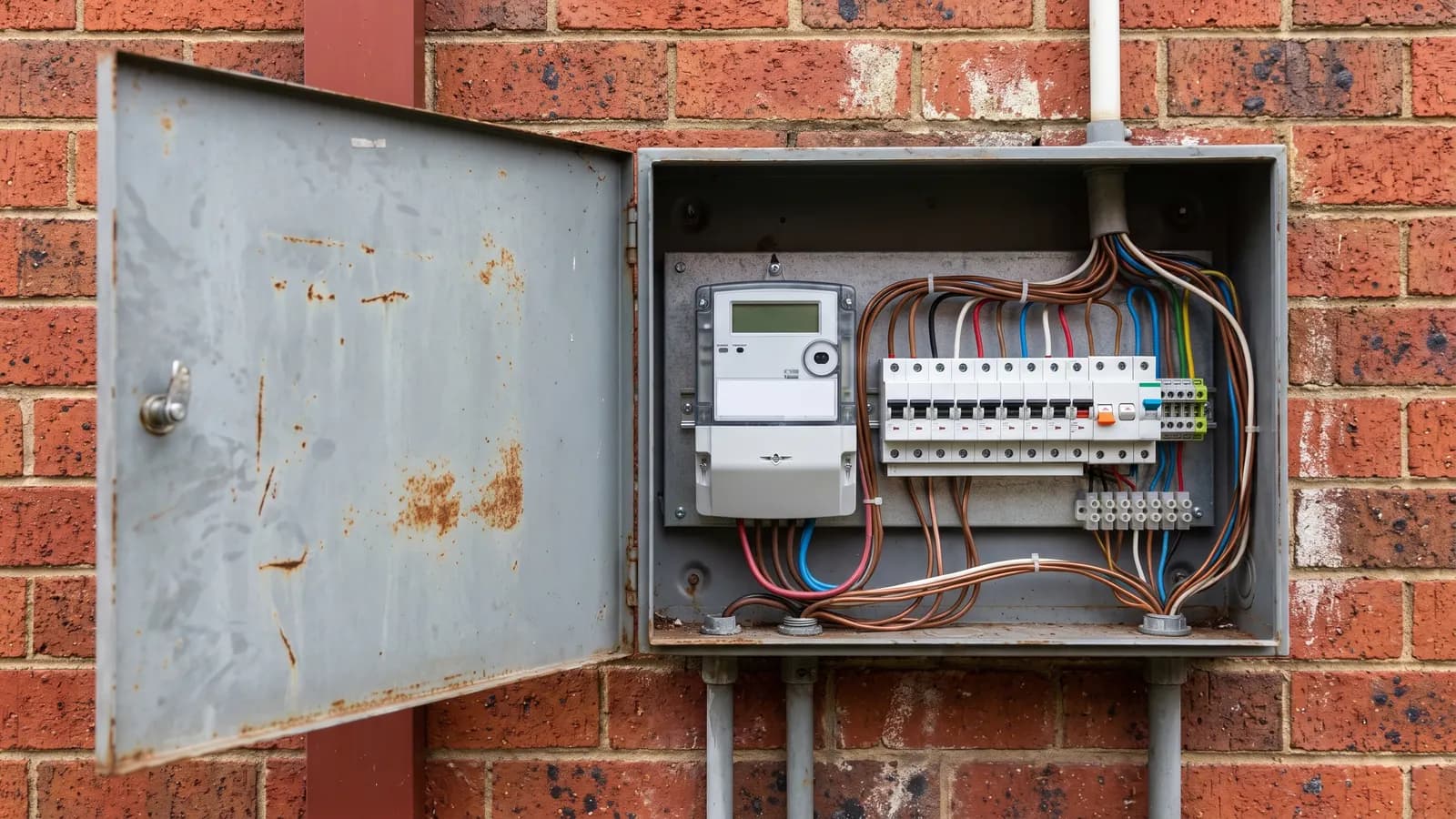
Your switchboard is the grey or cream-coloured box on an exterior wall, usually near the front door, in the garage, the laundry, or sometimes in a linen cupboard. Open the cover and find the main switch, typically the largest switch at the top of the board labelled “Main Switch” or “Mains.”
Single-phase
The main switch is a single, narrow toggle about one pole wide. It has two positions: on and off. Think of it like a standard light switch, just bigger.
Three-phase
The main switch is noticeably wider, spanning three poles joined together into one unit. It looks like three switches fused side by side. Some boards show three separate mains labelled L1, L2, and L3.
This is the fastest method for most people. If your board is modern and accessible, you will have your answer in under thirty seconds.
Find out what your home actually needs
Free, takes 60 seconds, no obligation.
Method 2: Count the service fuses
Near your electricity meter (which is usually inside or just next to the switchboard), look for the main supply fuses. These are large black cylindrical or rectangular fuses, sometimes described as looking like thick black cylinders about the size of a large battery. They sit between the street supply and your meter.
The count tells you everything: one black service fuse means single-phase, three black service fuses means three-phase.
A note on safety: you are doing a visual check only. Do not remove, touch, or interfere with any fuses or wiring. Everything you need to see is visible from the outside.
Method 3: Read your electricity meter
Modern smart meters often print the phase information directly on the display or on a label on the meter body. Look for these codes:
| What you see | What it means |
|---|---|
| 1P2W | Single-phase, 2-wire. You have single-phase supply. |
| 3P4W | Three-phase, 4-wire. You have three-phase supply. |
| L1, L2, L3 on display | Three-phase. The meter is showing readings for each phase separately. |
| Single reading only | Likely single-phase. One reading, one supply circuit. |
Older accumulation meters (the ones with spinning dials) do not usually display phase information, so this method works best with a modern digital or smart meter. If you have the older style, use methods 1 or 2 instead.
Method 4: Check your bill or call your retailer
Your electricity bill sometimes shows phase type in the connection or meter details section, though it is not always listed clearly. A quicker route: call your electricity retailer (AGL, Origin, Energy Australia, Synergy, ActewAGL, or whoever your provider is) and give them your NMI number. That is the National Meter Identifier printed on your bill, usually an 11-digit number starting with “NMI.”
They can confirm your phase type from their records in about sixty seconds. It is also the right move if your meter box is in an awkward location or locked inside a shared common area.
Your rebate, worked out to your address
Then one Why Solar Approved installer near you, and fifteen minutes with a solar expert before you sign.
Method 5: Look at what is already running in your home
This one is not definitive, but it is a useful signal. Three-phase power is typically installed in homes with high-demand equipment that would overload a single-phase connection. If you have any of the following, there is a decent chance you are already on three-phase:
- Large ducted air conditioning system. Especially older or commercial-grade units.
- Electric vehicle fast charger (22kW three-phase). The slower 7kW single-phase chargers do not require it.
- Industrial-grade workshop equipment. Large lathes, welders, compressors.
- Commercial-grade electric oven or induction cooktop. Particularly in high-spec kitchens.
- Large pool heating system or spa. Combined with other heavy loads.
That said, do not rely on this alone. Some newer homes are built with three-phase supply as standard even without heavy appliances, and older homes occasionally have surprising load histories. Use methods 1 through 4 to confirm.
What your phase type means for solar
Once you know your phase type, it directly shapes the solar system your installer will quote you.
On single-phase, your inverter capacity is capped at 5kW by most Australian network operators, though some now allow up to 10kW with export limiting enabled. That translates to a solar array of roughly 6.6kW to 13.3kW of panels (you can oversize panels relative to the inverter by up to 133% in most cases). For the majority of suburban homes running under 20kWh per day, this is perfectly adequate.
On three-phase, you can typically install up to 15kW of inverter capacity without special approval (5kW per phase), supporting solar arrays well into the 15kW to 20kW range. A three-phase inverter also distributes your solar generation across all three circuits, which improves self-consumption and avoids export limiting on any single phase.
If you have three-phase supply and your installer quotes you a single-phase inverter, ask why. It can work technically, but it leaves a lot of efficiency on the table. For a deeper look at how phase type interacts with inverter choice, system sizing, and the upgrade decision, see our three-phase power and solar guide.
Planning an EV charger? Phase type matters there too
Single-phase EV chargers (the 7kW units that are standard on most Australian home installs) work fine on either single-phase or three-phase supply. They are the right choice for most households.
Three-phase chargers (typically 11kW or 22kW) require a three-phase supply. They charge compatible EVs significantly faster: a 22kW three-phase charger can add roughly 120km of range per hour, compared to around 45km per hour on a 7kW single-phase unit. If you drive a lot and have a large-battery EV, that speed difference is meaningful.
Most popular EVs in Australia, including the Tesla Model 3, BYD Seal, and Hyundai Ioniq 6, accept three-phase AC charging. Check your vehicle spec before deciding on charger type. For a full rundown, our best EV charger guide covers every model available in Australia with phase requirements listed.
Can you upgrade from single-phase to three-phase?
Yes, and it is a straightforward job for a licensed electrician coordinating with your local distribution network operator. The work involves running two additional cables from the nearest street transformer to your meter and upgrading your switchboard. Expect the process to take two to six weeks including distributor approvals, and budget between $2,000 and $5,000 depending on your location.
It is worth the investment if you are planning a solar system larger than 5kW, adding a fast EV charger, or running heavy-load equipment. It is less compelling if your energy use is modest and a standard 6.6kW solar setup is all you need.
If you are already getting solar quotes, ask your installer whether a three-phase upgrade makes sense for your situation. Many will coordinate the upgrade alongside the solar installation and can advise on whether the extra cost stacks up for your specific usage.
Safety reminder
All the checks described above are visual only. Do not remove meter covers, touch service fuses, or interfere with any wiring. If you cannot reach your switchboard safely, or if anything looks damaged or unusual, call a licensed electrician rather than investigating further yourself.
The next step
If you're considering solar panels or batteries for your home, Andy and the team can match you with one Why Solar Approved installer near you for a free written quote, and fifteen minutes with a solar expert before you sign.

Written by
Solar Installer Partner Relations
Connects homeowners with trusted, vetted solar installers across Australia. Andy works directly with installation companies to ensure quality standards and helps homeowners through the quoting process.
If you have any questions about the information in this guide, email andy@whysolar.com.au or call +61 2 5657 6527.