Solar Policy
Can the Grid Switch Off My Rooftop Solar?
The short answer is yes, but only in rare grid emergencies, and usually by turning down exports rather than cutting power to your home. Here is how minimum system load works, what changed for Spring 2026, and what regulators are proposing next.
Your solar rebate, checked before you sign
11 min read
Find out what your home actually needs
Social posts and sales decks love this question. Can the grid switch off my rooftop solar? The honest answer is yes, but the scare version and the engineering version are miles apart.
Nobody is sitting in a control room toggling your panels off on a normal Tuesday. What exists is a chain of market notices, operator actions, and as a last resort instructions to your network to hold grid demand above a secure level. That can mean remote curtailment of solar exports. It has happened in South Australia a handful of times. It is why new solar in several states must be “emergency backstop” capable, including NSW from late 2026.
This piece walks through AEMO's minimum system load (MSL) framework, what changed for Spring 2026, how emergency backstop fits in, and the AEMC rule change on the table with a draft determination due 3 December 2026.
Why very low grid demand is a real problem
More than one-third of Australian homes now host rooftop solar, according to AEMO's MSL program page. On a mild, sunny weekend when air conditioners are off and millions of systems export at once, electricity demand measured at the transmission level can fall sharply. Rooftop solar is not visible to the market the same way a coal unit is, but it still displaces grid supply.
A large interconnected grid still needs enough synchronous machines, inertia, and controllable load to ride through faults. When operational demand drops too far, a credible contingency (such as losing a large generator or a transmission line) can push the system into an insecure state. That is the problem minimum system load management is trying to prevent. It is the mirror image of a summer peak, except the risk shows up in spring and autumn when solar is strong and heating and cooling loads are mild.
Batteries, electric vehicles and flexible hot water can absorb some surplus solar, but AEMO notes those capabilities are still limited in operations today and will take time to scale. Until then, emergency backstop for distributed PV is part of the toolkit.
Find out what your home actually needs
Free, takes 60 seconds, no obligation.
The MSL framework: MSL1, MSL2 and MSL3
AEMO introduced the mainland minimum system load framework in 2021 to coordinate action before the system is in trouble. The Spring 2026 procedure overview fact sheet defines three stages:
| Stage | What it means | Typical AEMO action |
|---|---|---|
| MSL1 | Grid demand is two credible contingencies away from an insecure state (MSL3). | Monitor and publish an MSL market notice with thresholds, sometimes up to seven days ahead. |
| MSL2 | One credible contingency from MSL3. | Try to clear the condition: recall outages, enable transitional services, issue directions to participants (including some generators and grid-scale batteries). |
| MSL3 | Demand is insufficient to maintain a secure operating state. | Use any remaining MSL2 tools, then instruct network service providers to maintain demand above the secure threshold. Real-time violations can require further demand increase, including management of reverse-power flows from distributed solar. |
Market notices are the public signal. They are updated when forecasts or actions shift the thresholds. For most households the practical impact stops at awareness: you might hear that a sunny Sunday could be tight for the grid, long before anyone touches rooftop solar.
If you follow wholesale markets, MSL periods also overlap with the negative price events that show up when solar floods the middle of the day. MSL is the security layer on top of that economic story.
What changed for Spring 2026
AEMO's August 2026 industry briefing describes a single mainland NEM MSL control room procedure, with a target go-live from 1 September 2026. The MSL1/2/3 labels are familiar, but operators refined how steps are sequenced and how grid-scale batteries are directed.
Under the incoming procedure, large batteries are generally left to the market unless an MSL2 or MSL3 condition coincides with insufficient state-of-charge headroom across the fleet, or an MSL3 is within about 90 minutes. That is a change from earlier seasons when direction timing could be much earlier in the day. Directed batteries may be allowed limited charging during a direction rather than being held at zero output for the whole event.
None of that is about your rooftop inverter directly. It matters because it shows AEMO trying to clear MSL2 conditions through market participants before calling networks to raise demand. Household curtailment sits at the sharp end of that queue.
Emergency backstop and remote curtailment
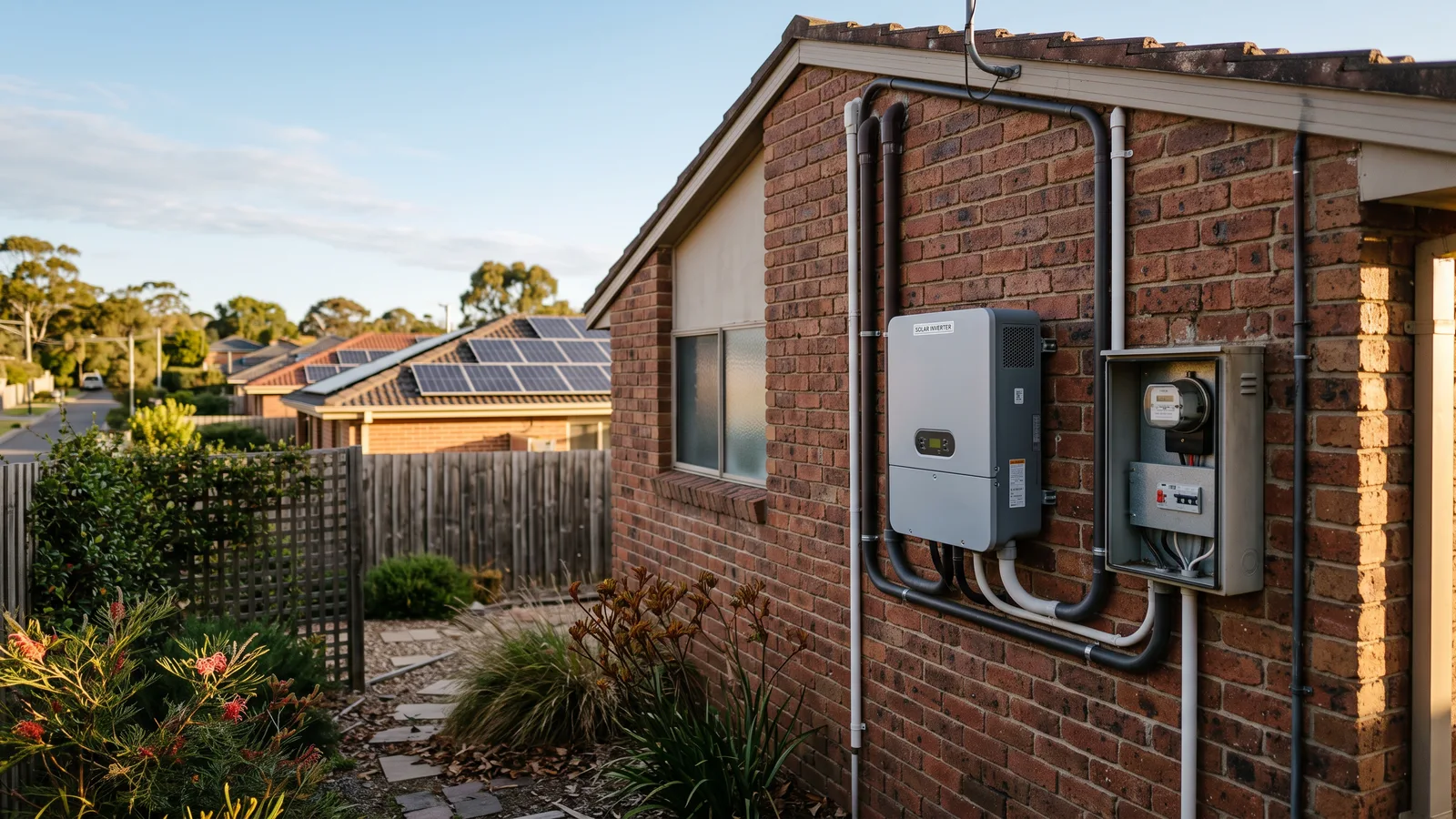
Emergency backstop is the capability for a network, when instructed by AEMO, to reduce distributed solar exports or pause generation remotely. In South Australia this runs through Smarter Homes requirements and registered “Relevant Agents” under CSIP-Aus. Other states have their own implementations; NSW is rolling requirements in for new and upgraded systems from late 2026.
AEMO's incident library on the MSL page is worth reading if you want ground truth instead of rumours:
- 14 March 2021 (SA): AEMO instructed SA Power Networks to keep operational demand above the secure minimum. Smarter Homes curtailed a small amount of rooftop PV for a short period, the first use of that framework.
- 13 to 19 November 2022 (SA island): After storm damage separated South Australia from the rest of the NEM, curtailment ran on multiple days for between about four and nine hours, reaching roughly 410 MW at peak.
- 15 February 2024 (SA): With interconnector risk elevated, about 51 MW of distributed PV was curtailed (46 MW above 200 kW via SCADA, 5 MW below 200 kW via Relevant Agents).
In each case the trigger was an MSL-style security problem, not a general desire to throttle solar. Households kept their lights on. The change was how much solar pushed into the grid at a moment when the system could not safely absorb it.
If you are comparing states, our solar export limits guide covers everyday connection rules. Emergency backstop is separate: it is not the 5 kW export cap on your approval, it is the rare override when AEMO says the secure minimum demand has been breached.
Record rooftop output in October 2026 (and curtailment that is not the backstop)
Spring 2026 has pushed rooftop solar output on the National Electricity Market to new highs. On Sunday 11 October 2026, NEM rooftop PV hit an instantaneous output record of 17,488 MW at 12:00pm, beating the prior record of 16,993 MW set on 20 September 2026, according to analysis cited by Renew Economy (Geoff Eldridge, Global Power Energy NEMLog data).
The same sunny weekend brought record renewable curtailment in Victoria: an instantaneous peak of 5,709 MW at 12:15pm on 11 October, about 15 minutes after the NEM rooftop record. That figure is mostly large-scale wind and solar that was available but not dispatched because of network limits or market conditions. It is not the same mechanism as emergency backstop curtailment of home exports during an MSL3 event.
For household systems, remotely switching off or throttling your rooftop solar remains a last resort in the minimum system load framework described above. Day to day, you are far more likely to see voluntary limits: your inverter capping export to stay within a DNSP approval, a battery soaking up surplus generation, or a VPP orchestration program trimming export when prices are low. Those are contractual or settings-based choices (or connection rules), not AEMO instructing your network to hold demand above a secure threshold.
Emergency backstop is the rare override when the secure operating state is at risk and other MSL tools are exhausted. Record rooftop output on a spring Sunday shows why the grid needs flexible load and storage, but it does not mean your panels were remotely switched off that afternoon unless a documented backstop event was in play. South Australia's published incident list remains the ground truth for when that last-resort step has actually been used.
Your rebate, worked out to your address
Then one Why Solar Approved installer near you, and fifteen minutes with a solar expert before you sign.
What this means if you own rooftop solar
For most installed systems today, the answer to “can the grid switch off my solar?” is still “not unless you are in a documented emergency, and even then it is usually export curtailment, not a blackout.” Existing NSW systems are outside the new backstop mandate; new installs face capability testing and internet communication requirements described in our NSW backstop guide.
During an event you might see export drop to zero for a period, or generation pause briefly. Self-consumption in the home can continue depending on how the inverter and network implement the instruction. A battery charged from your own panels can still cover evening use even if export was limited at midday.
Longer term, the policy direction is not to punish solar owners but to integrate millions of distributed systems without breaking security. That means more flexible exports, more storage, and clearer market signals. AEMO is also building a Demand Side Statement of Opportunities report, flagged for release in December 2026, to quantify how much households and businesses can contribute through flexible load.
On the economics side, AEMO CEO Daniel Westerman told the 2026 AFR Energy and Climate Summit that homes with batteries draw on average 70 to 75 per cent less power from the grid at peak times than homes with rooftop solar alone, across several quarters of data. That behaviour reduces pressure on peak plant and network peaks even when owners never opt into a VPP.
The AEMC rule change on the table
Operations are only half the story. On 9 July 2026 the AEMC opened consultation on two linked rule change requests:
- ERC0439 (Reliability Panel): an MSL governance framework in the National Electricity Rules, plus a requirement to set the regional spot price at the market floor price (currently minus $1,000 per MWh) when demand is expected to be insufficient for secure operation.
- ERC0417 (Clean Energy Council): a new MSL reserve ancillary service so responsive load, including grid-scale storage, pumped hydro and behind-the-meter resources, can bid to provide dispatchable reserves to increase demand during forecast MSL periods.
Submissions on the consultation paper closed on 20 August 2026. The Commission plans a draft determination by 3 December 2026, with a statutory extension reflecting the complexity of the issues. Final rule change timing stretches into 2027 (the docket lists expected completion around 8 April 2027).
For households, the floor-price element is mostly wholesale market architecture. Retail bills still include network and environmental charges. The reserve service proposal is more direct: it is an attempt to pay flexible resources to absorb surplus solar before anyone reaches for emergency curtailment. Whether that translates into new VPP-style products for home batteries will depend on how the final rule is drafted and what retailers build on top.
The bottom line
Yes, the grid can curtail rooftop solar in rare minimum system load emergencies. AEMO has a transparent MSL notice framework, updated procedures for Spring 2026, and a public record of when backstop mechanisms were used. For most owners the realistic risk is a handful of hours across years, not routine remote control of your system.
If you are buying solar now, emergency backstop capability is becoming standard in several states. Ask your installer how your inverter communicates, what happens to self-consumption during a curtailment instruction, and whether a battery changes your export profile. If someone uses MSL to argue you should skip rooftop solar entirely, compare that pitch to the actual incident list and to how often spring sunshine saves you money the other 364 days of the year.
Sources
The next step
If you're considering solar panels or batteries for your home, Andy and the team can match you with one Why Solar Approved installer near you for a free written quote, and fifteen minutes with a solar expert before you sign.

Written by
Solar Installer Partner Relations
Connects homeowners with trusted, vetted solar installers across Australia. Andy works directly with installation companies to ensure quality standards and helps homeowners through the quoting process.
If you have any questions about the information in this guide, email andy@whysolar.com.au or call +61 2 5657 6527.