
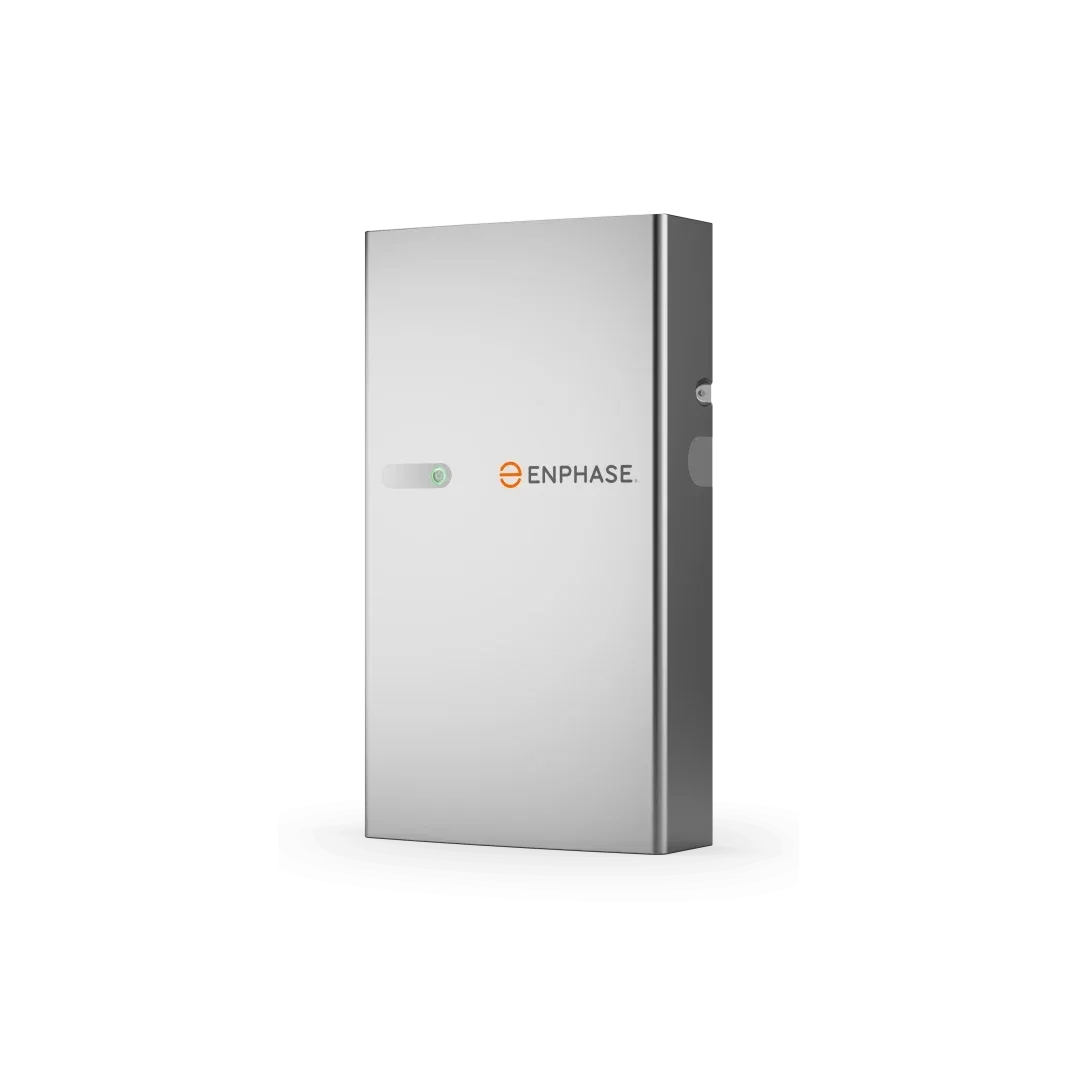

IQ Battery 5P 5kWh
- Power
- 3.84kW continuous
- Modular
- Yes
- Capacity
- 5kWh
- Usable capacity
- 5kWh
Warranty: 15 years
One Why Solar Approved installer, one written quote, and a 15-minute call with a solar expert before you sign.
By Bec Ramirez
The Enphase IQ Battery 5P is a 5.0 kWh usable AC-coupled home battery with six microinverters built into the unit. It is the third generation of the Enphase battery system and the only Enphase battery we found on the Clean Energy Council approved list. Enphase sells it in Australia in two versions: the original single-phase 5P, and the 5P with FlexPhase, which can be set up for single-phase or three-phase homes at several power levels.
Most people reading this page have a quote that names a 5P, or already run Enphase microinverters and want to know what a battery adds. Four facts matter most. Enphase rates one unit at 3.84 kVA continuous, so a bigger home usually needs more than one. The Enphase data sheet says the IQ System Controller 3 INT is required for grid-tied and backup operation. The warranty is 15 years or 6,000 discharged cycles, whichever comes first. And the exact model on your quote decides whether the federal battery rebate applies, because the original 5P and the FlexPhase versions sit on the approved list under different entries with different end dates.
Below we cover the specifications, what the 5P works with, how many units a system can take, the warranty terms, price context and the difference from the older IQ Battery 10T. Every fact was checked on 26 October 2026, and where a figure comes from a retailer or trade site and not from Enphase or a regulator, we say who reported it. For the broader review, see our Enphase IQ Battery review.
Two versions and the rebate list
The original IQ Battery 5P (Enphase SKU IQBATTERY-5P-1P-ROW, unit B05-T02-ROW00-1-2) is single phase with a fixed 3.84 kVA output. The 5P with FlexPhase (SKU IQBATTERY-5P-3P-INT) has the same 5.0 kWh and the same six microinverters, but the installer sets the output. Enphase lists single-phase ratings of 1.65, 2.5, 3, 3.68 and 3.84 kVA, and three-phase ratings of 1.84, 2.5, 3, 3.68 and 3.84 kVA. Enphase says all batteries in one FlexPhase system are set to the same power rating. If you are in a three-phase home, the FlexPhase is the version built for it.
The federal Cheaper Home Batteries program only pays on models on the Clean Energy Council approved battery list. We searched the list on 26 October 2026. It has 11 Enphase entries, all IQ Battery 5P. The original 5P is certificate BAT-404, approved on 2 May 2023, and the list shows an expiry date of 29 October 2026. The FlexPhase is certificate BAT-646, approved on 31 July 2025, with ten model numbers (five power levels in single-phase and in three-phase form) and an expiry of 31 December 2027. We could not find a published statement on whether the original listing is being renewed, so confirm the exact model number and its listing date with your installer before you sign.
A 5.0 kWh battery earns 34 certificates on an install in 2026, about $1,360 at $40 each, and 28 from 1 January 2027 when the factor steps down. Two units, at 10 kWh, earn 68 certificates, about $2,720. The Clean Energy Regulator also requires an installer with a Solar Accreditation Australia battery endorsement, and a battery that can join a virtual power plant. Enphase describes the 5P as VPP ready, but which programs accept it is for the retailer to confirm. The federal rebate page has the full working, and rebate figures here are indicative.
What the specifications mean
Enphase's Australian data sheet gives 5.0 kWh of usable energy, and a depth of discharge of 100%. The battery is lithium iron phosphate. Continuous output is 3.84 kVA at 230 volts (16.7 amps), with a peak of 7.68 kVA for 3 seconds and 6.14 kVA for 10 seconds. Enphase's owner's guide says the battery can supply up to 200% overload current, which helps start a motor such as a pump or compressor, but only when installed with the IQ System Controller 3 INT. Enphase's store page writes the same output as 3.84 kW, while the data sheet uses kVA, so treat them as the same rating.
Arithmetic helps here. 3.84 kVA is enough for essentials such as the fridge, lighting and a few outlets. Several large loads at once, such as an oven, ducted cooling and an EV charger, would exceed it. That is why a larger home is usually designed with more than one unit.
Round-trip efficiency is 96% measured on the DC side and 90% from AC in to AC out at 50% power at 25 degrees Celsius. The AC figure is the one that reflects energy going in and out of the home. Enphase also says each unit loses roughly 150 to 400 Wh a day to power its own electronics, which it calls tare loss, and that this is normal for home batteries.
The unit measures 980 x 550 x 188 mm and weighs 66.3 kg to lift and 78.9 kg installed. It has an IP55 rating, cools passively with no fans, and mounts on a wall or on a pedestal that is sold separately. Enphase's compliance guide for Australia asks for 150 mm of clearance around the unit for servicing and for installation to follow AS/NZS 5139, which sets distances from windows, doors and appliances outdoors. The FlexPhase weighs 83 kg on Enphase's store page.
What the 5P works with
The 5P is AC-coupled, so it connects on the AC side of the house rather than to the solar panels. Enphase's data sheet says it is compatible with IQ Series and S Series microinverters, and the store page lists IQ8, IQ7 and S Series. The FlexPhase store page also lists string inverters. Our Enphase IQ Battery review covers how it fits next to a non-Enphase inverter, and your installer should confirm the exact arrangement for your roof. With IQ8 microinverters, Enphase says there is no solar-to-storage ratio limit.
Two parts of the Enphase system are required. The data sheet states that the IQ System Controller 3 INT is required for grid-tied and backup operation. The controller includes the automatic switch that disconnects the home from the grid in an outage, and it is rated at 80 A per phase in Enphase's compliance guide. Enphase also requires that the installer holds Enphase University certification to commission the battery and controller.
The 5P is not backwards compatible. Enphase says it uses wired control cabling, works only with the IQ System Controller 3 and the IQ Combiner 5, and cannot be paired with the earlier wireless generation, including the IQ Battery 10T. If you already have a 10T, a 5P cannot join that system. Enphase's FAQ block does not label which country this answer is for, so ask your installer if you have an older system.
Backup and how many units you can add
A 5P with the IQ System Controller 3 INT can run partial-home backup, where chosen circuits are kept on, or whole-home backup, according to Enphase's owner's guide. The backup runtime depends on what you run and how many units you have, because one unit holds 5.0 kWh and delivers 3.84 kVA. In a grid-tied configuration without backup, the battery handles self-consumption and time-of-use savings, and Enphase says it can charge from the grid if that mode is turned on in the app.
We could not confirm a maximum number of units for Australia. Enphase's Australian documents we read do not give one. Enphase's 2025 launch release says the FlexPhase scales from 5 kWh to 70 kWh. Its store FAQ says up to 12 units on one IQ Gateway Metered if the local grid operator allows, but that answer does not say it applies to Australia. When the 5P launched here in 2023, pv magazine Australia reported configurations of 5 to 20 kWh. Retailer pages disagree with each other, with limits of 4 and 16 units quoted. The installer's design under your network's rules sets the real limit, so treat any single number as unconfirmed.
The 5P stacks with other 5Ps, not with older Enphase batteries. We found nothing on mixing the original 5P and the FlexPhase in one system. Enphase's compliance guide documents wiring for two units, including the wire sizes, so a two-unit system is a standard design. The federal rebate counts batteries by usable capacity, and each battery in a group needs at least 5 kWh nominal capacity, which a 5P meets exactly.
Warranty terms
Enphase's warranty for Australia and New Zealand, effective 15 June 2025, covers the 5P for 15 years or 6,000 discharged cycles from the activation date, whichever comes first. The activation date is the earlier of registering the battery or activating it in the Enphase Installer Portal. One cycle a day for 15 years is 5,475 cycles, so a battery cycled once a day reaches 15 years before it reaches the cycle limit.
The capacity guarantee is at least 70% of the nameplate rating at the end of year 10 and at least 60% at the end of year 15. The data sheet summarises this as more than 60%, and the warranty document is the more specific source. The IQ System Controller carries a separate 10 year warranty, and the gateway, relay and communications parts carry 5 years.
Several conditions apply. Enphase says the battery should stay continuously connected to the internet. Damage that a current firmware version would have avoided is not covered. Batteries activated after the "Energize by" date on the unit or its packaging are not covered. Claims must be made within 90 days of discovering a defect. The cost of removing, installing and troubleshooting your electrical system is not covered. A new owner keeps the cover if the battery stays at the original address, they submit a change of ownership form and pay the transfer fee within 30 days.
We found no recall or safety notice for the IQ Battery 5P. The Clean Energy Council recalls page, which lists ACCC recalls of products it has approved, has no Enphase entry. We could not check the ACCC's Product Safety Australia site directly, so look for the product there as well if you want to be certain.
What it costs
We do not have our own price range for the 5P yet, so these are retailer figures and indicative only. Aussie Solar Tech (page updated 16 July 2026) lists a 5P at $4,940, an IQ System Controller at $2,200 and installation at $1,000 to $3,000, for an estimated $8,140 to $10,140 for one unit. Compare the line items on any quote, including the controller, which is a separate cost.
The controller is its own line on the quote whether you add one unit or several, and the rebate is counted on usable kWh, so a single 5.0 kWh battery earns a small rebate. For scale, our price guide puts the 10.08 kWh IQ Battery 10T at $14,000 to $15,000 installed before rebates. Our price guide for the Tesla Powerwall 3 puts that battery at $15,000 to $17,000.
IQ Battery 5P compared with the 10T
The IQ Battery 10T is the older generation. Aussie Solar Tech lists it at 10.08 kWh usable and a 3.84 kW rating from twelve microinverters. We could not open an Australian 10T data sheet, so check those figures against your quote. If they hold, the 10T holds twice the energy behind the same output, while two 5Ps hold the same energy and double the output.
The more important differences are not in the specification table. The 5P uses wired communication and a newer controller, and the two generations cannot be mixed. We found no IQ Battery 10T on the Clean Energy Council approved list, and the 5P is the only Enphase battery on it. If you want the federal rebate with an Enphase battery, the 5P is the one that can earn it, and the 10T page covers the rest.
All specifications
- Power
- 3.84kW continuous
- Modular
- Yes
- Capacity
- 5kWh
- Usable capacity
- 5kWh
- Round-trip efficiency
- 96%
Who it suits
A good fit
- You already have, or are buying, Enphase microinverters and want a battery in the same app.
- You want a battery you can add to in 5 kWh steps as your usage grows.
- You want the long warranty, 15 years or 6,000 cycles, and a battery that is on the approved list for the federal rebate.
- You live in a three-phase home and want the FlexPhase version with several power levels.
Look elsewhere if
- You need more than 3.84 kVA from one unit. A single 5P will not run several large appliances at once.
- You want to add to an existing IQ Battery 10T. The 5P cannot be paired with the older generation.
- You want the lowest cost per kWh. The controller is a fixed extra cost that weighs on a small battery.
- Your quote names the original 5P and you want the rebate. Confirm its listing is current at installation.
Alternatives to compare
- Enphase IQ Battery 10T
The older Enphase generation, with about twice the energy in one box. It cannot pair with a 5P and we found it absent from the approved list. $14,000 to $15,000 installed before rebates on our price guide.
- Tesla Powerwall 3
A single 13.5 kWh unit with a built-in solar inverter and 11.5 kW continuous power, against 3.84 kVA per 5P. $15,000 to $17,000 installed before rebates on our price guide.
- Sungrow SBR 12.8
A DC-coupled battery that needs a Sungrow SH hybrid inverter, which suits a new solar system and not an Enphase one. $8,500 to $10,500 installed before rebates on our price guide.
- BYD Battery-Box Premium HVM 11.0
A modular DC battery that pairs with a compatible hybrid inverter such as the Fronius GEN24. $8,500 to $11,500 installed before rebates on our price guide.
Common questions
How much usable capacity does the Enphase IQ Battery 5P have?
Enphase's Australian data sheet gives 5.0 kWh of usable energy per unit, with a depth of discharge of 100%. The nominal capacity is also 5.0 kWh. The chemistry is lithium iron phosphate.
What is the power output of the IQ Battery 5P?
The original 5P is rated at 3.84 kVA continuous, with a peak of 7.68 kVA for 3 seconds and 6.14 kVA for 10 seconds. The 5P with FlexPhase is set by the installer to 1.65, 2.5, 3, 3.68 or 3.84 kVA on single phase, or 1.84, 2.5, 3, 3.68 or 3.84 kVA on three-phase. Enphase says it can also supply up to 200% overload current to start large loads when installed with the IQ System Controller 3 INT.
Does the Enphase IQ Battery 5P need an IQ System Controller?
Yes, according to Enphase's Australian data sheet, which says the IQ System Controller 3 INT is required for grid-tied and backup operation. The controller is a separate cost that has to be on your quote. It carries its own 10 year warranty.
Is the IQ Battery 5P eligible for the Cheaper Home Batteries rebate?
Yes, the models are on the Clean Energy Council approved list, which we searched on 26 October 2026. The original 5P is certificate BAT-404 with an expiry date of 29 October 2026, and the FlexPhase models are certificate BAT-646 with an expiry of 31 December 2027. A 5.0 kWh battery earns 34 certificates on an install in 2026, about $1,360 at $40 each. Confirm the exact model number and listing with your installer.
How many Enphase IQ Battery 5P units can I install?
We could not confirm a maximum for Australia. Enphase's Australian documents give wiring for two units, its 2025 FlexPhase release says systems scale from 5 kWh to 70 kWh, and retailer pages quote different limits. The design limit depends on the controller, the gateway and your network's rules, so your installer sets it. A 5P can only be combined with other 5P batteries, not with the older IQ Battery 10T.
What is the warranty on the Enphase IQ Battery 5P?
Fifteen years or 6,000 discharged cycles from the activation date, whichever comes first. Enphase guarantees at least 70% of nameplate capacity at the end of year 10 and at least 60% at the end of year 15. The battery should stay connected to the internet, and claims must be made within 90 days of discovering a defect.
What is the difference between the IQ Battery 5P and the IQ Battery 10T?
The 10T is the older generation, listed by Aussie Solar Tech at 10.08 kWh usable, about twice the 5P. The 5P is newer, uses wired communication and a different controller, and cannot be paired with a 10T. It is on the Clean Energy Council approved list and we found no 10T on it. Two 5Ps match the 10T on energy and double its output.
How much does the Enphase IQ Battery 5P cost in Australia?
We do not have our own price range for it yet. Aussie Solar Tech (updated 16 July 2026) estimates $8,140 to $10,140 for one unit including the IQ System Controller and installation. Treat it as indicative and compare line items on a written quote.
Can the IQ Battery 5P work as backup during a blackout?
Yes, when it is installed with the IQ System Controller 3 INT. Enphase describes partial-home and whole-home backup configurations. One unit holds 5.0 kWh and delivers 3.84 kVA, so how long and how much it can run depends on the loads you choose and how many units you have.
Sources
- Enphase, IQ Battery 5P data sheet for Australia and New Zealand (DSH-00020-6.0, 8 August 2025), checked 26 October 2026.
- Enphase, Warranty for storage systems, Australia and New Zealand (effective 15 June 2025), checked 26 October 2026.
- Clean Energy Council approved batteries list (searched through the CEC site's own search), checked 26 October 2026.
- Enphase Australia, IQ Battery 5P product page, checked 26 October 2026.
- Enphase Australia, IQ Battery 5P with FlexPhase product page, checked 26 October 2026.
- Enphase, Energy System with IQ Battery 5P owner's guide for Australia (USG-00018-4.0), checked 26 October 2026.
- Enphase, Energy System Installation Compliance Guide for Australia and New Zealand (TEB-00047-3.0, May 2024), checked 26 October 2026.
- Clean Energy Regulator, Solar batteries (program rules), checked 26 October 2026.
- Clean Energy Council, Product recalls (no Enphase entry), checked 26 October 2026.
- Enphase press release, 11 August 2025, as reproduced by Finviz (the Enphase investor site could not be opened), checked 26 October 2026.
- pv magazine Australia, Enphase's third generation IQ battery system launches in Australia (23 May 2023), checked 26 October 2026.
- Aussie Solar Tech, Enphase IQ Battery 5P review (page updated 16 July 2026, installer), checked 26 October 2026.