EV Chargers

Charge your electric vehicle at home with solar power. A charger that follows your solar output can take the running cost of the car close to zero.

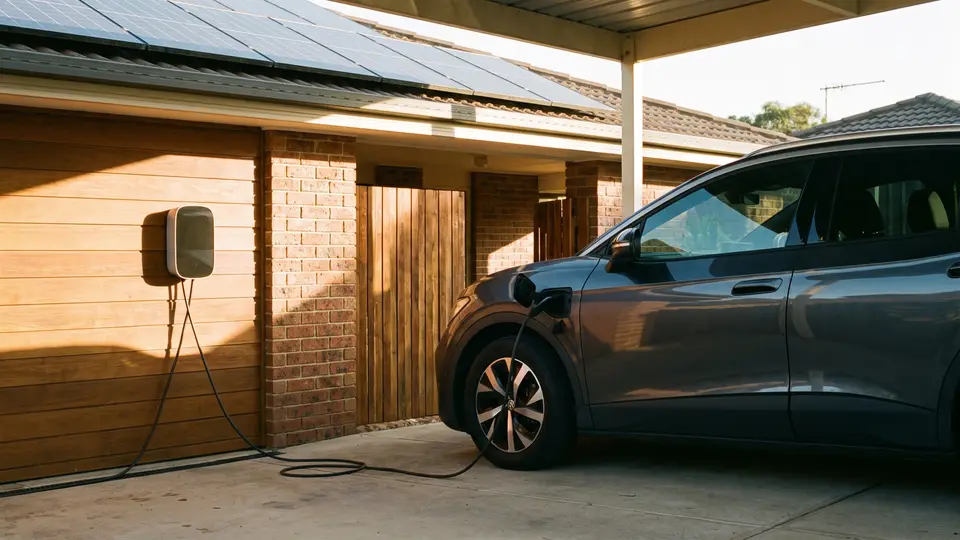
Grey electric SUV plugged into a wall-mounted charger in a carport, with solar panels on the roof above
Home charging
7 to 22kW
Solar powered
100%
Per km on solar
$0.02
Fuel saved a year
$1,500+

EV charger levels explained

EV chargers are grouped by power. More power charges faster, but it needs the wiring to match.
  • Level 1

    Emergency backup only

    Power
    2.4kW
    Charge speed
    10 to 15km/hour
    Connector
    Standard outlet
    Installation
    No installation
    Cost
    $0 (included with EV)
  • Level 2 (7kW)Most homes

    Most Australian homes

    Power
    7kW
    Charge speed
    40 to 50km/hour
    Connector
    Type 2 / Tesla
    Installation
    Single-phase
    Cost
    $1,500 to $3,000
  • Level 2 (22kW)

    Three-phase homes, fast charging

    Power
    22kW
    Charge speed
    100 to 130km/hour
    Connector
    Type 2
    Installation
    Three-phase required
    Cost
    $2,500 to $4,500

Our recommendation: a 7kW Level 2 charger. It suits most Australian homes and adds about 40 to 50km of range an hour, enough to fully charge overnight. Three-phase homes can consider 22kW for faster charging.

Solar-smart charging modes

A smart charger can follow your solar output and adjust the charge rate on its own. These are the usual modes.
  1. Full solar (Eco)

    Only charges when excess solar is available. Zero grid power.

    Cost
    $0 charging cost
    Speed
    Slower, weather dependent
  2. Solar boost

    Uses solar first, tops up from grid to maintain minimum charge rate.

    Cost
    Balanced cost and speed
    Speed
    Moderate, consistent
  3. Fast charge

    Maximum power regardless of solar. For when you need range quickly.

    Cost
    Fastest charging
    Speed
    Full charger speed
  4. Scheduled

    Charges during off-peak times (for example overnight) when rates are lowest.

    Cost
    Low off-peak rates
    Speed
    Set charge time

Top EV chargers

Six chargers worth shortlisting, chosen for solar integration and smart features. Our charger reviews go deeper on each.

Zappi

Best solar integration

7kW / 22kW

  • Solar integration
  • Eco/Eco+ modes
  • Load balancing
  • App control

The strongest solar diversion of the group. Charges only when solar is available, or tops up from the grid.

Installed price

$1,800 to $3,200

Tesla Wall Connector

Best for Tesla owners

7.4kW / 11kW / 22kW

  • Tesla integration
  • Power sharing
  • Sleek design
  • WiFi enabled

Built for Tesla vehicles and the Tesla app. Up to 4 units can share power.

Installed price

$900 to $1,500

Fronius Wattpilot

Best with Fronius inverters

11kW / 22kW

  • Solar optimised
  • Fronius integration
  • App control
  • RFID

Talks directly to a Fronius inverter, so it charges from surplus solar without extra hardware.

Installed price

$2,000 to $3,000

OCPP Universal

Most flexible option

7kW / 22kW

  • Open protocol
  • Multiple brands
  • Smart features
  • Future-proof

Works with any EV and can connect to various energy management platforms.

Installed price

$1,200 to $2,500

Wallbox Pulsar Plus

Compact and stylish

7.4kW / 22kW

  • Compact design
  • Power sharing
  • Scheduling
  • Myenergi compatible

Small footprint with powerful features. Good solar integration with third-party systems.

Installed price

$1,400 to $2,200

ABB Terra AC

Commercial reliability

7.4kW / 11kW / 22kW

  • Commercial grade
  • RFID
  • Heavy-duty build
  • OCPP 1.6J

Industrial-quality charger suitable for demanding home or business applications.

Installed price

$2,000 to $3,500

What 15,000km a year costs to fuel

Charging an EV on solar costs a fraction of petrol. Here is how the three options compare over a typical year of driving.
Petrol car8L/100km at $1.80/L$2,160/yr
EV on grid power15kWh/100km at $0.30/kWh$675/yr
EV on solar power15kWh/100km at about $0.05/kWh*$112/yr

*Solar cost based on the feed-in tariff you give up by using the power yourself. Actual savings depend on your solar system size and usage patterns.

Annual savings, charging on solar
Against petrol
$2,048/yr
Against grid charging
$563/yr
Over 10 years
$20,480+

Based on 15,000km a year. Your actual savings will vary with your driving, your electricity rates and your solar system size.

EV demand is climbing fast

EV sales in Australia grew 65% in 2025, with over 180,000 new EVs on the road. Fitting the charger before the car arrives saves a slow first few weeks on a power point.

  • 1 in 5 new cars sold in Australia is now electric.
  • 80% of EV charging happens at home.
  • Solar and an EV charger save $2,000+ a year in fuel.

EV charger rebates in 2026

  • Limited direct rebates. Unlike solar and batteries, EV chargers currently have limited specific rebates in most states. The savings come from charging with solar power.
  • Bundle opportunities. Some installers offer EV charger discounts when bundled with solar or battery installations. Ask about package deals.
  • The real saving is solar charging. The biggest incentive is free fuel. Charge with solar and save $1,500 to $2,500 a year compared to petrol.
Bundle with solar

What installation involves

  1. Site assessment

    The electrician checks your switchboard capacity, the cable run and where the charger will mount.

  2. Electrical upgrade

    If needed, they upgrade your switchboard or install a dedicated circuit.

  3. Charger installation

    Mounting and wiring. Typically 2 to 4 hours for a standard install.

  4. Configuration

    Set up the app, connect to WiFi, configure solar integration and charging schedules.

Included in installation

  • EV charger unit
  • Up to 10m cable run
  • Dedicated circuit breaker
  • Certificate of compliance
  • App setup and training

May need extra work

  • Switchboard upgrade (if at capacity)
  • Cable runs over 10m
  • Three-phase connection
  • Trenching for underground cables
  • Load management devices

Frequently asked questions

Can I charge my EV from a regular power point?
Technically yes, but it's very slow (only about 10km of range an hour). A dedicated EV charger is 4 to 10 times faster and safer for regular use. The portable charger that comes with the car is best kept for emergencies.
Do I need three-phase power for an EV charger?
No. A 7kW single-phase charger suits most homes and adds about 40 to 50km of range an hour, enough to fully charge overnight. Three-phase enables 22kW charging but isn't necessary for most users.
How much does it cost to charge an EV at home?
With grid power at $0.30/kWh, driving 100km costs about $4.50. With solar, it can be nearly free. Compare this to about $14 to $18 for the same distance in a petrol car.
Can my solar system handle EV charging?
A 6.6kW system can fully support a 7kW charger during sunny hours. Smart chargers adjust to available solar. For maximum self-consumption, consider a larger solar system or charging during peak sun.
Are there rebates for EV chargers in Australia?
Currently, EV charger-specific rebates are limited. Some state programs include charger incentives when bundled with solar or batteries. The main savings come from charging with solar power, reducing running costs to near zero.
What happens if I charge while cooking dinner?
Smart chargers with load management automatically reduce charging power to prevent overloading your switchboard. The charger resumes full speed when other loads decrease.

Installation guide

What an EV charger installation needs, what it costs and what happens on the day.

Read the installation guide

Charger reviews

Zappi, Tesla, Fronius and the other popular home chargers, reviewed and ranked.

Read the reviews

Charge your EV with sunshine

The charger is the easy part. The solar is what makes it cheap to run. Up to $8,000+ in solar and battery rebates. One Why Solar Approved installer, one free written quote, and fifteen minutes with a solar expert before you sign. Ask them which charger suits your car and your switchboard.

Up to $8,000+ in solar and battery rebates · Federal rebates step down in 80 daysSee how we calculate this