
Independent. Not owned by an installer or an energy retailer.
Solar quotes from one Why Solar Approved installer, checked by an expert before you sign.
We match you with one installer who has passed all six of our checks. Then a solar expert walks you through your rebate and your quote before you sign: what it should include, what to push back on, whether a battery makes sense. It's the call we never had, and it comes with every match.
60 seconds. Free. The installer never cold-calls you; your expert calls at a time you choose.
- Why Solar Approved installers only
- 5 stars on Google
- No cold calls, ever
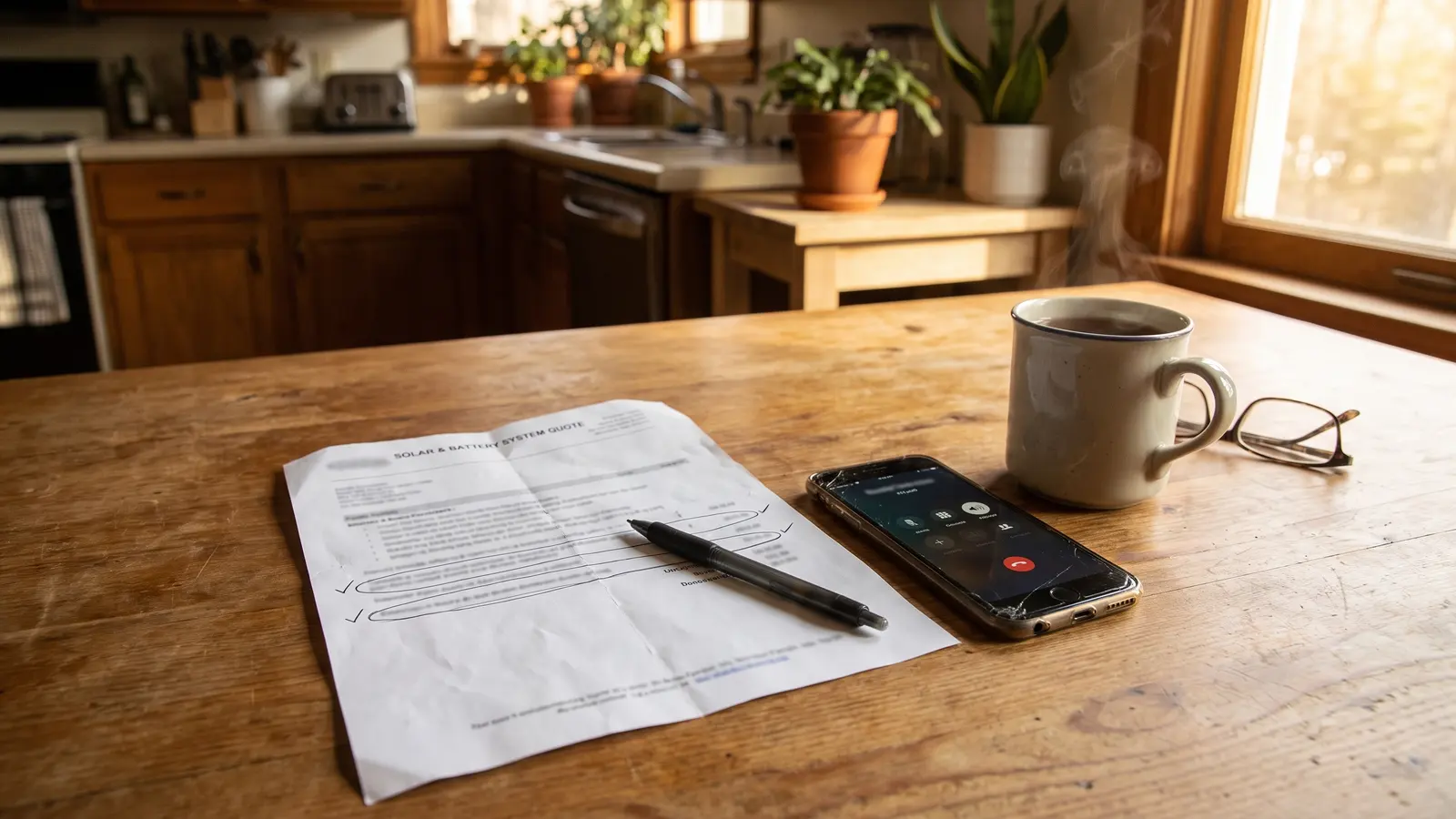
Already have a quote? Get it checked before you sign. We review what is included and send you a written summary.
Your rebate in 60 seconds
Your postcode and a few questions. We work out the federal and state rebates for your home. No account, no sales call.
One Why Solar Approved installer
One installer who has passed all six of our checks, and one written quote. They never cold-call you.
Your expert call before you sign
Fifteen minutes with a solar expert, at a time you choose: the size, the rebate and your quote, line by line.
What every match includes.
One approved installer, an expert on your side, and someone checking the installer did what they promised.
- One Why Solar Approved installer
- One written quote, from an installer who passed all six of our checks.
- Your expert call
- Fifteen minutes before you sign: the right size, your rebate, and your quote line by line.
- No cold calls
- The installer never cold-calls you. Your expert calls when you choose.
- A check-in after the install
- We call you afterwards to check the installer delivered what they promised.
- Owners who live on solar
- Independent and family owned, by two people who run their home on solar and batteries.
- Free for you
- Free for homeowners. Installers pay us a set fee for each introduction, not a commission on what you buy.
Start with your rebate. Everything above comes with the match.
Before you sign, talk to the expert we never had.
When we went solar there was no one independent to check the quote against, and it cost us dearly. So every Why Solar match includes a 15-minute call with one of our solar experts before you sign anything. Not a sales call. We don't sell solar.
You pick the time. The installer never cold-calls you.
What we go through with you
- Whether the system is the right size for your bill, not the biggest the rebate covers
- Your rebate, and what the installer has to show for it on the quote
- Your quote, line by line: panels, inverter, battery, the workmanship warranty
- What to push back on before you sign
- Whether a battery makes sense for your home, or not yet
Fifteen minutes. Not a sales call. Part of every match.
60 seconds, then you pick a time for the call.
Already have a quote from someone else? Get it checked before you sign.
What a fair solar quote looks like in 2026
A solar quote in Australia is usually written after the federal STC rebate has been taken off, so the figure at the bottom is the figure you pay. The table below is what a fair quote looks like for the common residential sizes: the installed price before the rebate, the rebate itself, and what is left. The rebate depends on your STC zone, which is set by your postcode, so it is shown as a range from the smallest zone rebate to the largest.
- 5 kW10 to 12 panels
- Installed price before STCs$4,500 to $6,500Federal STC rebate$1,102 to $1,520Typical price after STCs$2,980 to $5,398
- 6.6 kW12 to 15 panels. The size most homes quote on
- Installed price before STCs$5,500 to $8,000Federal STC rebate$1,482 to $2,014Typical price after STCs$3,486 to $6,518
- 10 kW18 to 22 panels
- Installed price before STCs$8,000 to $12,000Federal STC rebate$2,242 to $3,078Typical price after STCs$4,922 to $9,758
- 13 kW24 to 30 panels
- Installed price before STCs$10,000 to $15,000Federal STC rebate$2,926 to $3,990Typical price after STCs$6,010 to $12,074
The rebate column runs from STC Zone 4 (Melbourne and Hobart) up to Zone 1 (Alice Springs and Karratha). The city list further down shows the zone for each capital, and the STC calculator works the rebate out for your own postcode and system size.
The federal solar rebate is not a cash payment from government. It is a number of small-scale technology certificates (STCs) your system creates, which your installer trades and applies to your quote as an upfront discount. The value moves with the certificate market.
All quotes, savings estimates, and rebate calculations provided through our website are indicative only. Final pricing and rebate amounts will be confirmed by your assigned installer following a site assessment. Actual savings may vary based on energy usage, system performance, and electricity rates.
Figures correct as at 2 September 2026.
A quote lands above the band for reasons that are usually legitimate: microinverters or optimisers instead of a string inverter, a two-storey or steep roof, a switchboard that needs upgrading before the system can be connected, or a regional address with travel built in. A quote well below the band deserves the same scrutiny in the other direction: a shorter workmanship warranty, an inverter you cannot find a review for, or panels described as premium without a model number.
The install date matters as much as the price. The STC rebate shrinks every 1 January as the deeming period behind it gets a year shorter, so the same 6.6 kW system installed a year later carries about $304 to $418 less rebate. A quote that shows this year's rebate but an install date in the next is worth asking about.
None of those are reasons to walk away on their own. They are reasons to ask, and the expert call is where you ask them. Our solar panel cost guide goes through each of them, with prices by city.
What a solar quote must include
A quote you can sign is one you can read. Before the expert call, and before you sign anything, check that every item below is on the page. If one is missing, ask for it in writing. A good installer will not mind, and a Why Solar Approved installer already puts it there.
Line items, not one number
The system price, the STC discount, any state rebate and the amount you pay, each on its own line. A single total hides what was and was not included.
Panel make, model and count
The brand, the model number and the wattage of each panel, and how many. "Tier 1 panels" or "premium European panels" is not a model number.
Inverter make and model
The inverter is where most price differences between quotes come from. The quote names the brand and the model, its size, and whether it can run a battery now or later.
Who holds each warranty
Product warranties come from the manufacturer. The workmanship warranty comes from the installer, and it only lasts as long as they do. The quote says who holds each one and for how long.
Your export limit
Your network sets how much your system can send to the grid, and that changes what a bigger system is worth. The quote states the limit that applies to your home and whether a connection application is needed.
Rebate assignment
The STCs your system creates are assigned to the installer, who trades them and takes the value off the price. The quote says so and shows the figure. It does not leave the rebate for you to claim later.
Timing and the paperwork
The install date, who lodges the grid connection application, who arranges the electrical compliance certificate, and how the meter change is handled.
Our guide to reading a solar quote goes through each section of a quote in detail: the system size, the panels, the inverter, the battery line, the rebates, the compliance steps and the two kinds of warranty.
Solar and battery quotes
- Federal rebate on a 10 kWh battery, about
- $2,584
A battery is now part of many solar quotes, and the federal Cheaper Home Batteries Program is a large part of why. The rebate is worth about $258/kWh of usable capacity on the first 14 kWh, and it comes off the quote the same way the solar STCs do. On a 10 kWh battery that is about $2,584. On a 14 kWh battery it is about $3,610.
A 10 kWh battery is typically quoted at $10,000 to $14,000 installed before the rebate, so $7,416 to $11,416 after it. The full rate drops to about $217/kWh on 1 January 2027, so the same battery installed after that date earns a smaller rebate.
Whether a battery makes sense for your home is one of the four things the expert call covers. It depends on when you use your power, what your retailer pays for exports, and whether your state adds anything on top of the federal rebate. A battery quote needs the same things a solar quote does, plus the usable capacity in kWh, whether it gives you backup power during an outage, and whether the inverter quoted can run it.
The battery cost guide has prices by size and by brand, and the federal battery rebate page has the program rules, the step-down schedule and the state schemes that stack with it.
Solar quotes by city
A quote changes from city to city with the STC zone, the network's export rules and the housing. Each city below has a page on its installers and a page on what is actually being installed there, from the Clean Energy Regulator's postcode data.
Solar quotes in Sydney, NSW
STC Zone 3. The rebate on a 6.6 kW system is about $1,710. 38,383 systems installed in the last 12 months, averaging 11.5 kW.
Solar quotes in Melbourne, VIC
STC Zone 4. The rebate on a 6.6 kW system is about $1,482. 32,218 systems installed in the last 12 months, averaging 9.5 kW.
Solar quotes in Brisbane, QLD
STC Zone 3. The rebate on a 6.6 kW system is about $1,710. 32,959 systems installed in the last 12 months, averaging 10.2 kW.
Solar quotes in Perth, WA
STC Zone 3. The rebate on a 6.6 kW system is about $1,710. 26,832 systems installed in the last 12 months, averaging 9.3 kW.
Solar quotes in Adelaide, SA
STC Zone 3. The rebate on a 6.6 kW system is about $1,710. 17,638 systems installed in the last 12 months, averaging 10.8 kW.
Not in one of these five cities? The match runs on your postcode, and every installer we match has passed the same six checks.
The Why Solar Approved standard
Every installer clears all six checks
A warranty is only as good as the company behind it. Before an installer earns Why Solar approval, they pass every one of these. Most don't.
Credentials
Accreditation and licensing, current and genuine, checked rather than assumed.
Staying power
Years actually trading, and the financial stability to still be here in a decade to honour what they promise.
Proof of work
Real installations we can examine, not a folder of stock photos and slogans.
The actual hands
Who physically turns up to do the job, not the cheapest available subcontractor.
What goes in
Genuine, traceable components that match the quote exactly. No quoting German and fitting Chinese.
How they handle trouble
How they behave when something goes wrong. That, not the sales call, is the true measure of a company.
Solar quote questions
How many solar quotes should I get?
One checked quote beats three unchecked ones. What protects you is not the number of quotes but knowing what a fair one looks like, and a pile of quotes you cannot read side by side does not give you that. A Why Solar match gives you one quote from an installer who has already passed the six checks of the Why Solar Approved standard, and fifteen minutes with a solar expert who goes through it with you line by line before you sign: your rebate, what the quote should include, and what to push back on. More quotes also means more companies with your phone number and more sales processes to sit through. If you already hold a quote from somewhere else, upload it to QuoteCheck and a Why Solar expert goes through what is included.
How much should a 6.6 kW solar system cost?
In 2026 a 6.6 kW system is typically quoted at $5,500 to $8,000 installed, before the federal STC rebate. The rebate on that size is worth $1,482 to $2,014 depending on your STC zone, so the price on the quote after the rebate usually lands at $3,486 to $6,518. Microinverters, a steep or two-storey roof, or a switchboard upgrade push it higher. A figure well below the band needs a closer look at the inverter and the workmanship warranty.
What should a solar quote include?
The system size, the panel and inverter models with their wattage and count, and the full price with the STC discount and any state rebate shown as their own lines. The product warranties and the installer's workmanship warranty, with who holds each. The export limit that applies to your home, who lodges the grid connection and compliance paperwork, and the install date. If a battery is included, its usable capacity and whether it gives you backup power during an outage.
Are solar quotes free?
Yes. The quote from your Why Solar Approved installer is one free, no-obligation written quote, and the expert call is free too. Installers pay us a set fee for each introduction, not a commission on what you buy. You never pay us, and nothing is charged if you decide not to go ahead.
Can I get a solar battery quote?
Yes. Choose "Solar & Battery" or "Battery Only" on the first question of the quiz and your installer quotes the battery as well. The federal battery rebate comes off the quote in the same way as the solar STCs, about $258/kWh on the first 14 kWh, and the expert call covers whether a battery makes sense for your home before you commit to one.
What happens after I request a quote?
You see your rebate estimate straight away, and your details go to one installer: one Why Solar Approved installer near you, matched to your postcode. Your solar expert calls at the time you picked, or rings to find a time that suits, and the installer gives you one free, no-obligation written quote. Before you sign anything, the expert goes through it with you: your rebate, what the quote should include and what to push back on. We call Monday to Friday, 8am to 6pm.
What is the 20% rule for solar?
It means fitting about 20% more panel capacity than the inverter is rated for, so the inverter runs near its limit for more of the day. The ceiling is a third: on a system without a battery, the design guidelines accredited installers work to keep the panels to no more than 133% of the inverter's capacity, and a larger array is not eligible for STCs. That is why a 5 kW inverter is paired with 6.6 kW of panels, and a 10 kW inverter with up to 13.3 kW.
Is 10kW solar enough to run a house?
For most homes, yes, during the day. A 10 kW system in Melbourne makes about 12,720 kWh a year, roughly 35 kWh a day, and more in Brisbane or Perth. It will not run the house at night without a battery, so evening power still comes from the grid.
Why are people getting rid of their solar panels?
Mostly they are replacing a bad system, not giving up on solar. The usual causes are an installer that went broke and took the workmanship warranty with it, a cheap inverter that failed, or an export limit that stops the system earning what the salesperson promised. Our register lists 279 solar companies that have collapsed in Australia.
Your rebate, one Why Solar Approved installer, and an expert call before you sign.
60 seconds. Free. Your expert calls at a time you choose.