
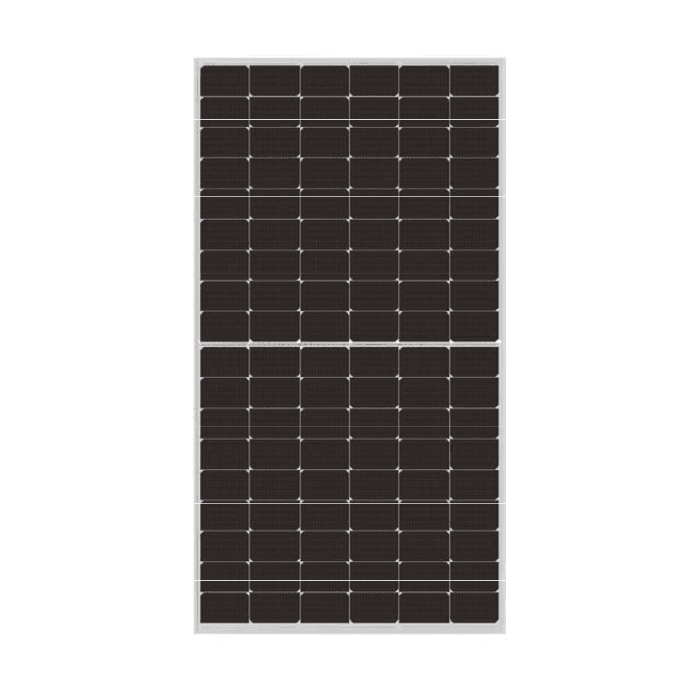

Tiger Neo 440W
- Type
- N-type TOPCon
- Cells
- 108 half-cut
- Weight
- 22kg
- Dimensions (mm)
- 1762x1134x30mm
Warranty: 25 years product, 30 years performance
One Why Solar Approved installer, one written quote, and a 15-minute call with a solar expert before you sign.
By Bec Ramirez
The Jinko Tiger Neo 440W is an N-type TOPCon solar panel with 108 cells, sold in Australia mainly as the JKM440N-54HL4R-B, the all-black version. It is a previous-generation Tiger Neo. Jinko Australia's residential range now shows only the Tiger Neo 3.0 (460 to 485 W), and its datasheet page lists no 54HL4R panel. We found no discontinuation notice, retailers still list the 440W, and the Clean Energy Council approvals run to 2027.
Most people reading this have a quote that names a Jinko 440W panel, or an installed system they want to check. Three facts matter more than the headline watts. The model code decides what you are getting, because Jinko sells monofacial, bifacial and dual-glass 440 W panels under similar names. Jinko's Australian warranty gives the common codes 25 years of product cover and a 30 year power guarantee that still leaves 87.4% at the end. And we found no recall of a Jinko solar panel.
Below we set out the model codes, what the specifications mean on a roof, the warranty terms and their conditions, the CEC listing for each code, and what is and is not known about track record. Every fact was checked on 26 October 2026 and the sources are listed at the end. Where a figure comes from a retailer or trade publication and not from Jinko or a regulator, we say who reported it.
Which model codes make up a 440W Tiger Neo
Jinko sells more than one 440 W panel under the Tiger Neo name, so the code on your quote matters more than the wattage. The one most Australian buyers mean is the 54HL4R family. JKM440N-54HL4R-B is the all-black version, and the Clean Energy Council list also holds JKM440N-54HL4R, JKM440N-54HL4R-V and two bifacial codes, JKM440N-54HL4R-BDB and JKM440N-54HL4R-BDV. The Clean Energy Council marks the first three as monofacial and the last two as bifacial. We did not find a Jinko page that defines each suffix, so ask which frame and backsheet colour your code has.
A second 440 W panel sits in Jinko's 48HL4M range. JKM440N-48HL4M-DV and -DB have 96 cells, glass on both sides, a 1500 V rating and a weight of 21.5 kg, and the Clean Energy Council lists them as monofacial. Jinko Australia's datasheet page lists the 48HL4M-DV (440 to 480 W) under the heading Archived Datasheets and does not list the 54HL4R. This page covers the 54HL4R family and says where the 48HL4M differs.
Do not confuse the 54HL4R with the 54HL4, which has no R. Jinko's 54HL4-B datasheet covers 405 to 420 W and gives a panel 1722 mm long, 40 mm shorter than the 54HL4R. The Clean Energy Council list has no JKM440N-54HL4 entry. If a quote says 440 W and 1722 mm, or names a 54HL4 code at 440 W, that does not match Jinko's datasheets and is worth querying.
The Tiger Neo 3.0 that Jinko Australia now leads with is a different panel with a different warranty table. Our best solar panels comparison covers it alongside six other ranges. If you want a Jinko system quoted, our Jinko installer page is where we match homeowners to installers.
What the specifications mean
Jinko's datasheet for the JKM440N-54HL4R-B gives 440 W at standard test conditions (open-circuit voltage 39.57 V, short-circuit current 13.80 A) and a module efficiency of 22.02%. Power tolerance is 0 to +3% on that sheet and plus or minus 3% on the Australian edition. The cells are N-type, and Jinko's global Tiger Neo page describes the technology as TOPCon. The panel measures 1762 x 1134 x 30 mm, weighs 22 kg, has 3.2 mm tempered glass, an anodised aluminium frame and an IP68 junction box. At about 2.0 square metres a panel, the 22.02% figure checks out against the dimensions.
The datasheet lists a power temperature coefficient of -0.29% per degree Celsius, which is how much output falls for each degree the cells run above 25 degrees. An earlier Australian edition of the same datasheet (a hosted copy) shows -0.30%, so the figure has been stated two ways. Jinko also lists 331 W for this panel at its nominal operating cell temperature conditions (800 W per square metre, 20 degrees ambient). That is a test condition, not a forecast for your roof, but it is a fairer guide to a hot afternoon than the 440 W label.
The -B version is rated to 1000 V system voltage with a 25 A series fuse rating. The datasheet says it resists salt mist and ammonia, and the Clean Energy Council entry for the -B code lists IEC 62804 (PID), IEC 61701 (salt mist) and IEC 62716 (ammonia) under its enhanced listing. The plain JKM440N-54HL4R code has no enhanced listing text. The two datasheet editions we read differ on mechanical load: 2400 Pa wind and 5400 Pa snow on the Australian edition, 4000 Pa and 6000 Pa on the 2023 global one. Ask your installer which applies to the panels delivered.
The -BDB and -BDV codes are bifacial, meaning the rear can collect light as well. We did not check their datasheets, so we do not state their weight or efficiency here. The 48HL4M-DV datasheet lists the same 22.02% and -0.29% figures for its 440 W row, with a 1500 V rating and operating range of -40 to +70 degrees.
What 440W means for a system, and what it costs
At 440 W a 6.6 kW array takes 15 panels, which covers about 30 square metres of roof before mounting gaps and setbacks. A 10 kW array takes 23 panels, or 10.12 kW. The same system in 460 to 485 W panels needs fewer panels.
The federal solar rebate on a 6.6 kW system is about $1,560 to $2,120 depending on your STC zone. That figure is indicative and your quote should show the certificate count. It is worked from system size, zone and years remaining, not from the panel brand, as long as the panel is on the approved list. The federal rebate page has the working.
Panel-only prices are a poor guide to what you pay, but they show where this panel sits. CHOICE's database shows $125.00 for the JKM440N-54HL4R-B. Treat it as indicative. It is not an installed price, since the inverter, mounting and labour are extra, which is why our 6 kW system price guide is the place to look for an installed figure.
Warranty terms
Jinko's Australian limited warranty (revision AU 1 August 2026, for purchase agreements signed on or after that date) lists JKMxxxN-54HL4R, -54HL4R-V and -54HL4R-B at a 25 year product warranty and a 30 year power warranty. First-year degradation is capped at 1.00% and each later year at 0.40%, which guarantees at least 87.40% of nameplate output at year 30. On a 440 W panel that is about 385 W. By Jinko's formula the floor is 99% after year one and 89.4% at year 25. The bifacial BDB and BDV codes carry the same terms, and so did the April 2024 bifacial edition.
The product warranty covers the panel and its DC connectors and cables against material defects in workmanship that impair performance. It excludes changes in appearance and normal wear. The clock starts on the earlier of delivery to the original purchaser or 180 days after the manufacture date in the serial number. A claim needs written notice within 30 days of finding the fault, lodged through Jinko's online after-sales platform with photos or test reports, serial numbers and proof of purchase. Jinko can send a panel to an independent lab, and the owner pays the testing cost if a breach is not established.
Jinko chooses the remedy: repair, replacement, a refund of residual value or the output shortfall, or extra panels. It pays shipping for its remedy, but dismantling, repacking and reinstalling are the owner's cost, which matters for panels on a roof. Exclusions include use outside Jinko's installation manual, moving the panel to another location, marine environments, panels bought through unauthorised channels and exposure above the maximum system voltage. The warranty can be assigned in whole to a new owner with written notice to Jinko. Australian Consumer Law guarantees apply on top and cannot be excluded.
Panels bought before 1 August 2026 may sit under an earlier edition. We could read the 2024 bifacial edition but not an earlier monofacial one, so ask your installer which revision covers your serial numbers. If your installer has gone out of business, the warranty document lists 1300 326 182.
CEC listing and the solar rebate
We searched the Clean Energy Council approved PV module list on 26 October 2026 for JKM440N. It returned seven 440 W Jinko codes, all certified to IEC 61215 and 61730 editions from 2021 and 2023. JKM440N-54HL4R-B and the plain JKM440N-54HL4R were approved on 28 June 2024 and expire on 28 June 2027 (certificate Z2 118443 0038 Rev. 03, TUV SUD). JKM440N-54HL4R-V was approved on 4 April 2024 and expires on 4 April 2027. The bifacial -BDB and -BDV codes were approved on 28 June 2024 and expire on 28 June 2027. The two 48HL4M codes were approved on 17 June 2025 and expire on 17 June 2028.
The Clean Energy Regulator requires a system's panels and inverter to be on the Clean Energy Council list for it to earn small-scale technology certificates. The listing is by exact model code, and listings expire, so check the code on your quote against the approved product list on the day it is installed. A 440 W panel earns the same certificates per kilowatt as any other approved panel.
Recalls, bankability and track record
The Clean Energy Council recall page, which reproduces ACCC notices, lists no Jinko solar panel recall as of 26 October 2026. Its only Jinko entry is dated 25 January 2024 and covers the SunTank hybrid inverter JKS-5HLVS-ABI, whose emergency power plug could be pulled out without a tool. The only solar panel notice on the page is for ECORAN (formerly SCHOTT Solar) modules made between 2010 and 2012 (PRA 2025/20435, 13 March 2025). We could not open Product Safety Australia, which returned an access error, so the absence of a panel recall is confirmed on the Clean Energy Council page and by web search only.
Jinko's Australian site says BloombergNEF ranked it the most bankable PV brand for 10 consecutive years, and that PV Tech gave it an AAA bankability rating from the first quarter of 2026. Those are Jinko's statements. We could not open the BloombergNEF list. An exporter's explainer on the first quarter 2026 list includes Jinko Solar and says the Tier 1 label measures a manufacturer's record in bank-financed projects, not module quality or efficiency. Bankability speaks to a manufacturer's standing with lenders, not to how this panel performs on your roof.
CHOICE lists the JKM440N-54HL4R-B in its solar panel database with Jinko's claimed specifications, but its test results are for members only and we have not seen them.
All specifications
- Type
- N-type TOPCon
- Cells
- 108 half-cut
- Weight
- 22kg
- Dimensions (mm)
- 1762x1134x30mm
- Efficiency
- 22.02%
Who it suits
A good fit
- You have a quote naming a JKM440N-54HL4R code and want to check its specifications, warranty and listing.
- You own an installed Tiger Neo 440W and want to know your warranty terms and how to claim.
- You want an all-black N-type panel of about 22% efficiency with 25 year product cover and a 30 year power guarantee.
- Your roof has room for roughly two square metres a panel and you are not chasing the highest output per panel.
Look elsewhere if
- Your quote lists a 440 W Tiger Neo with a code that does not appear on the Clean Energy Council list, or a size that does not match the datasheet.
- Roof space is tight and you need more watts per panel. Jinko's current Tiger Neo 3.0 reaches up to 24.27% and 485 W, and its Australian warranty guarantees 88.85% at year 30.
- You want the lowest published temperature coefficient. This panel lists -0.29% or -0.30% per degree depending on the datasheet edition.
- You cannot confirm which warranty revision applies to panels bought before August 2026.
Alternatives to compare
- Jinko Tiger Neo 580W
A larger Tiger Neo for bigger arrays. Check its exact code: Jinko's Australian warranty table gives 72 cell Tiger Neo codes 12 years of product cover, against 25 years for the 54HL4R.
- Aiko Neostar 2S 470W
An N-type back-contact panel. Aiko's datasheet lists 23.6% efficiency, -0.26% per degree and 0.35% a year after a 1% first year, against 22.02%, -0.29% and 0.40% for this Jinko.
- Best solar panels in Australia
Our comparison of seven panel ranges, including the current Jinko Tiger Neo 3.0, with efficiency, warranty and degradation side by side.
Common questions
What is the exact model code of the Jinko Tiger Neo 440W?
Most Australian installs use JKM440N-54HL4R-B, the all-black version. The Clean Energy Council list also holds JKM440N-54HL4R, JKM440N-54HL4R-V, the bifacial JKM440N-54HL4R-BDB and JKM440N-54HL4R-BDV, and the newer JKM440N-48HL4M-DV and -DB. Check which code is on your quote.
What are the specifications of the Jinko Tiger Neo 440W?
The JKM440N-54HL4R-B is 440 W at standard test conditions, with 22.02% efficiency, 108 N-type cells, dimensions of 1762 x 1134 x 30 mm and a weight of 22 kg. Its open-circuit voltage is 39.57 V and its short-circuit current is 13.80 A. The system voltage rating is 1000 V.
What is the warranty on the Jinko Tiger Neo 440W in Australia?
Jinko's Australian warranty lists the 54HL4R codes at 25 years of product cover and 30 years of power cover. First-year degradation is capped at 1.00% and later years at 0.40%, leaving at least 87.40% of nameplate output at year 30. Panels bought before 1 August 2026 may sit under an earlier revision, so confirm the one that applies.
Is the Jinko Tiger Neo 440W on the Clean Energy Council approved list?
Yes. We searched the list on 26 October 2026. JKM440N-54HL4R-B and the plain JKM440N-54HL4R are listed to 28 June 2027, JKM440N-54HL4R-V to 4 April 2027, and the bifacial -BDB and -BDV codes to 28 June 2027. Listings are by exact model code and they expire, so check your code on the day of installation.
Is the Jinko Tiger Neo 440W bifacial, and is it black or silver?
The JKM440N-54HL4R-B is monofacial and all-black, according to its datasheet title and the Clean Energy Council listing. The -BDB and -BDV codes are bifacial. We did not find a Jinko page defining the plain and -V suffixes, so ask your installer for the frame and backsheet colour of the code quoted.
What is the temperature coefficient of the Jinko Tiger Neo 440W?
Jinko's 2023 datasheet for the 54HL4R-B lists -0.29% per degree Celsius for power. An earlier Australian edition of the same datasheet lists -0.30%. Either way, output falls by under a third of a percent for each degree the cells run above 25 degrees.
Has the Jinko Tiger Neo 440W been recalled?
We found no recall of a Jinko solar panel on the Clean Energy Council recall page on 26 October 2026. Jinko's only listed recall, dated 25 January 2024, is for the SunTank hybrid inverter JKS-5HLVS-ABI. We could not open the Product Safety Australia site, so check it for any newer notice.
Is the Jinko Tiger Neo 440W still current, or has it been replaced?
It is a previous-generation panel. Jinko Australia's residential range now shows the Tiger Neo 3.0, at 460 to 485 W, and its datasheet page does not list the 54HL4R. We found no discontinuation notice, and retailers and the Clean Energy Council list still carry the 440W.
How many Jinko Tiger Neo 440W panels make a 6.6 kW system?
15 panels make 6.6 kW, taking about 30 square metres of roof before mounting gaps. A 10 kW array takes 23 panels, or 10.12 kW.
Sources
- Clean Energy Council, approved PV modules list (searched for JKM440N through the list's own search), checked 26 October 2026.
- Jinko Solar Australia, Limited Warranty REV.AU20260801, monofacial modules, checked 26 October 2026.
- Jinko Solar Australia, Limited Warranty REV.AU20260801, bifacial modules, checked 26 October 2026.
- Jinko Solar, Tiger Neo 54HL4R-B 420 to 440 W datasheet (global edition F3, 2023), checked 26 October 2026.
- Jinko Solar, Tiger Neo 54HL4R-B datasheet, Australian CEC edition (2022, hosted copy), checked 26 October 2026.
- Jinko Solar Australia, JKM440-480N-48HL4M-DV datasheet, checked 26 October 2026.
- Jinko Solar Australia, 54HL4-B 405 to 420 W datasheet (hosted copy, used for the 1722 mm length), checked 26 October 2026.
- Jinko Solar Australia, datasheets page (headed Archived Datasheets), checked 26 October 2026.
- Jinko Solar Australia, residential range and company claims (bankability statements are Jinko's own), checked 26 October 2026.
- Jinko Solar, global Tiger Neo page (TOPCon description), checked 26 October 2026.
- Jinko Solar Australia, Limited Warranty REV.AU20240401, bifacial modules (hosted copy), checked 26 October 2026.
- Clean Energy Council, product recalls page (reproduces ACCC notices), checked 26 October 2026.
- Clean Energy Regulator, rooftop solar (panels and inverter must be on the approved list), checked 26 October 2026.
- Aiko Solar, Neostar 2S54 440 to 470 W datasheet (used for the Aiko comparison), checked 26 October 2026.
- CHOICE, Jinko Tiger Neo JKM440N-54HL4R-B listing (claimed specifications and price; test results are members only), checked 26 October 2026.
- VicoExport, Tier 1 list of solar panel manufacturers Q1 2026 (exporter's explainer on the BloombergNEF list), checked 26 October 2026.