
Commercial Solar
The Commercial Solar Rebate Just Grew Tenfold: What the 1MW SRES Expansion Means
From 1 October 2026 the federal small-scale rebate covers commercial systems up to 1MW, ten times the old 100kW limit. Here is what it is worth, who benefits most, and how it stacks with state incentives.
Get a free commercial solar quote
9 min read
See if your business is solar-ready
For years, the federal solar rebate stopped dead at 100 kilowatts. Under that ceiling, a business got the same upfront point-of-sale discount that homeowners enjoy. One kilowatt over it, and the discount vanished entirely. So businesses did the rational thing: they put 99.9kW systems on warehouse roofs that could comfortably carry three or four times that, and kept buying the rest of their daytime power from the grid.
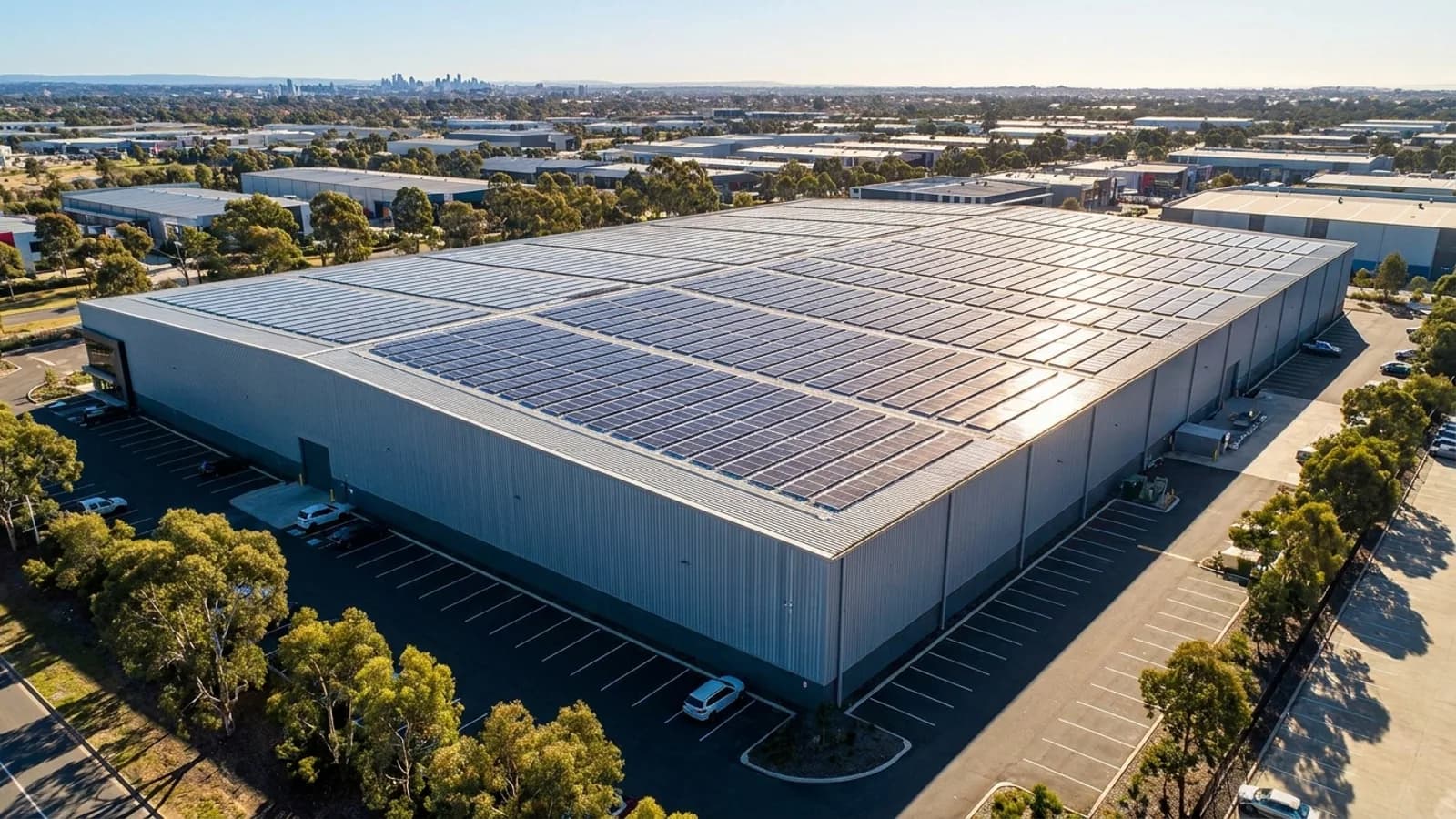
That cliff is being removed. From 1 October 2026, the federal Small-scale Renewable Energy Scheme will cover commercial solar systems all the way up to 1 megawatt, a tenfold increase. The Government reckons it takes around 20% off the installed cost of a medium-sized system, and it describes the roofs it is targeting as Australia’s “missing middle”: the factories, warehouses, cold stores, farm sheds and shopping centres that sit between household rooftops and utility-scale solar farms.
It is a genuinely big change for anyone with a large roof and a daytime electricity habit. Here is what actually changed, what the discount is worth, who stands to gain the most, and the fine print worth knowing before you sign anything.
What actually changed
The mechanism itself is not new. Small-scale solar earns Small-scale Technology Certificates, or STCs, which your installer typically sells on your behalf and passes back to you as an upfront discount on the invoice. It is the same scheme behind the “rebate” on a household 6.6kW system. The only thing that has moved is the size limit: the point where a system stops qualifying as small-scale has been lifted from 100kW to 1MW.
That sounds like a technicality. In practice it removes a distortion that has been shaping commercial roofs for years. The 100kW cap was a hard edge, not a taper, so the sensible move was to design right up to 99.9kW and stop, even on a roof begging for more. Lifting the ceiling to 1MW lets a business size a system to the roof and to its actual daytime load, rather than to a rebate threshold. The Government puts the untapped opportunity at more than 80GW of commercial rooftop potential against only around 5.6GW installed so far.
See if your business is solar-ready
Free assessment, no obligation.
What the rebate is worth
The discount scales with system size, at roughly 20% of the installed cost. The Government offered two worked examples when it announced the change: a retailer installing a 250kW system saving close to $70,000, and a large retail complex or logistics warehouse saving more than $230,000 on an 850kW system. At the same rate, a 400kW system lands at roughly $110,000 off the upfront price.
The table below is a rough guide at that rate. STCs are traded on an open market, so the real figure moves with the certificate price on the day, your solar zone and your installer’s pricing. Treat it as a sense of scale, not a quote.
| System size | Indicative upfront discount | Notes |
|---|---|---|
| 100 kW | around $27,000 | The old ceiling |
| 250 kW | around $70,000 | Government example |
| 400 kW | around $110,000 | At the same rate |
| 850 kW | more than $230,000 | Government example |
The upfront discount is only part of the return. A commercial solar system also cuts your daily power bill, and businesses can generally claim depreciation on the asset, which sharpens the after-tax payback further. Our guide on solar panel depreciation and the ATO covers how that side works for a business.
Who benefits most
The winners are easy to spot: a big roof paired with high daytime consumption. Solar pays back fastest when you use the power yourself as it is generated, rather than exporting it for a modest feed-in tariff, so the best fit is a business that runs hard through the middle of the day and has the roof or ground space to match.
- Warehouses and logistics
- Cold storage and food
- Manufacturing and factories
- Farms and agribusiness
- Retail and shopping centres
- Schools and clubs
Cold storage and refrigerated food businesses are a particularly neat fit, because their heaviest load, the compressors, runs all day and peaks in the same summer heat that drives the best solar output. The same logic applies to any operation whose plant hums from nine to five. If most of your consumption lands after dark, solar alone does less for you, and the conversation shifts towards pairing it with storage.
The NSW angle: stacking with the Peak Demand Reduction Scheme
You will see it claimed that NSW businesses can “stack” the expanded rebate with Peak Reduction Certificates under the state’s Peak Demand Reduction Scheme. That is true, but it is worth being precise about what earns what, because the wording often implies more than it should.
Your solar panels earn federal STCs. The NSW Peak Demand Reduction Scheme does not pay for solar generation at all; it rewards cutting demand during peak periods, which in practice usually means a battery. So the way the two actually stack is that a business installing solar and a battery claims federal STCs on the solar and NSW Peak Reduction Certificates (PRCs) on the battery. Two schemes, two pieces of equipment, both claimable on the one project. What you cannot do is earn PRCs on the solar array itself.
Read the stacking claim carefully
If a sales pitch suggests your bigger solar system will earn NSW certificates on top of the federal discount, ask exactly which certificates and on which equipment. The PRC value comes from the battery, not the panels. It is still a real, worthwhile stack when you install both, just not a second rebate on the solar.
See what your business can claim on solar
Based on your power bill and your business address.
Faster grid connections
For a lot of mid-scale projects, the upfront cost was never the only barrier. Getting the network to approve a larger connection has been slow and unpredictable, and an uncertain connection timeline can stall a business case just as effectively as a big invoice. Alongside the rebate change, the Government has said it will ask the Australian Energy Market Commission to require network providers to approve commercial and industrial connections more quickly.
That reform still has to work its way through, and it does not remove the need to apply. But it signals that the connection queue, not just the price, is finally being treated as part of the problem. If you are scoping a larger system, start the connection conversation with your network and installer early, because that timeline often sets the pace of the whole project.
The fine print worth knowing
First, the timing. The expanded eligibility applies from 1 October 2026. Because the certificates are created around when the system is installed and confirmed, a job above 100kW that is finished too early could fall under the old rules. If you are planning a larger system, talk to your installer about how the build schedule lines up with the start date so you claim the full entitlement.
Second, the value is not fixed. STCs trade on an open market and the number of certificates a system creates is set to keep declining each year until the small-scale scheme ends in 2030, so the discount is generally worth more the sooner you act. We cover that wind-down in detail in our guide on what the STC phase-out means.
Third, keep the quoting honest. A larger job is a larger cheque, and that is exactly where loose pricing hides. Ask for the STC discount shown as a separate line, get the system sized to your roof and load rather than to a headline number, and compare two or three quotes. A legitimate installer will happily break the numbers down.
Were you quoted at 99.9kW?
Plenty of businesses were quoted just under the old cap to avoid losing the discount. If your roof or car park can carry more and your daytime load justifies it, that quote is worth revisiting under the 1MW rules. A properly sized system with the upfront discount often changes the payback maths for the better.
What to do now
If you have a big roof and you run through the day, this is worth pricing properly. Start by looking at your consumption profile: the more of your usage that falls in daylight hours, the stronger the case, because self-consumed solar is worth far more than exported solar. Then size the system to that load and the available roof, not to the old 100kW line.
From there it is the usual discipline. Get the connection conversation moving early, get itemised quotes with the discount shown separately, and, if you are in NSW and adding storage, work out the PRC side as its own line rather than folding it into a vague “rebate” number. The rebate has done the hard part by removing the cliff. The rest is sizing the system to your business and quoting it cleanly.
Sources
The next step
If you're considering commercial solar for your business, Andy and the team can match you with one vetted commercial installer for a free written quote.

Written by
Solar Installer Partner Relations
Connects homeowners with trusted, vetted solar installers across Australia. Andy works directly with installation companies to ensure quality standards and helps homeowners through the quoting process.
If you have any questions about the information in this guide, email andy@whysolar.com.au or call +61 2 5657 6527.