
Solar Guides
Balcony Solar Australia 2026: Plug-In Solar for Renters and Apartments
A category that is mainstream in Europe and emerging in Australia. Plug-in solar for renters, apartment residents, and anyone who cannot access a rooftop installation.
Renting? Start with your power plan.
Compare every plan in your postcode, including the ones your retailer does not advertise.
Compare electricity plans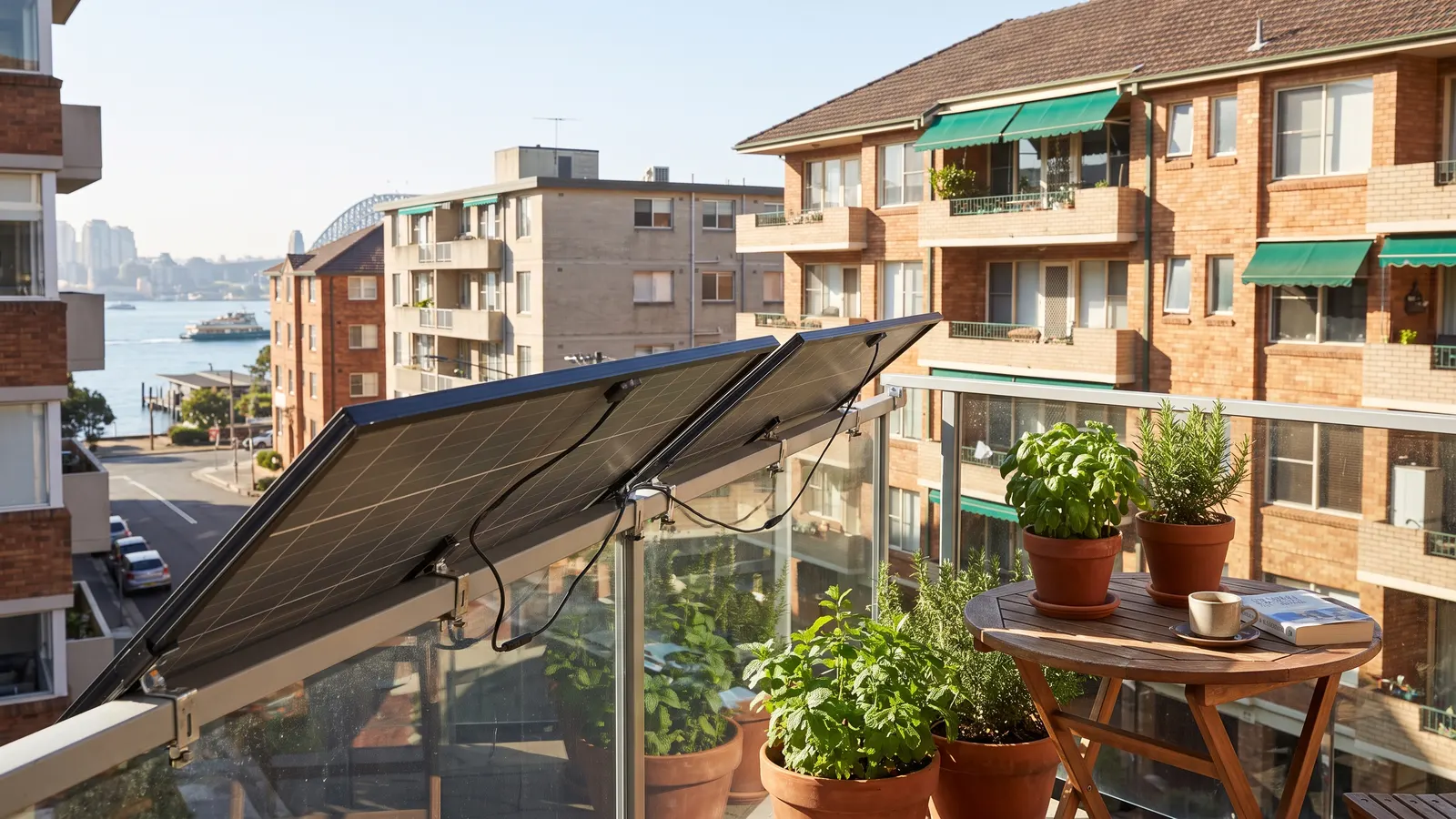
7 min read
Renting? Start with your power plan.
Compare every plan in your postcode, including the ones your retailer does not advertise.
Compare electricity plansWhy Balcony Solar Is a Different Category
Most solar content in Australia is written for homeowners with roof access. The 6.6kW system, the STC rebate, the CEC-accredited installer requirement: all of these assume you own a house and can physically mount panels on a roof. For the roughly 30% of Australians who rent, and the growing number who live in apartments, this entire category is out of reach.
Balcony solar addresses a different problem. A small number of panels mounted on a balcony railing, courtyard wall, or ground frame, connected through a micro-inverter and plugged into a power point: this requires no rooftop access, no structural modification, and in many configurations, no professional installation. In Germany, balcony solar (Balkonkraftwerk or Steckersolar) is a mainstream consumer category with clear regulations permitting systems up to 800W. Australia is following, though the regulatory framework is still developing.
How Plug-In Solar Works
A plug-in solar system consists of three components: one or two solar panels (typically 300W to 450W each), a micro-inverter or small string inverter designed for low-power output, and a connection cable that plugs into a standard Australian power point (or, in some configurations, connects directly to the switchboard via a licensed electrician).
When the sun generates electricity through the panels, the micro-inverter converts it from DC to AC at 240V, matching your home's mains voltage. This AC power feeds into the building's internal wiring at the point of connection. Any loads drawing power from that circuit are served first by the solar-generated electricity, with any shortfall coming from the grid. If solar generation exceeds local load on that circuit, the surplus can flow back through the meter toward the grid, though older meters may not credit this correctly.
The key difference from a rooftop system is scale and simplicity. A 400W plug-in system costs $400 to $800 total. It generates 1.2 to 1.6 kWh per day on average. It moves with you when you move. It requires no grid connection approval from a network operator for systems that don't export back to the grid.
Renting? Start with your power plan.
Compare every plan in your postcode, including the ones your retailer does not advertise.
Compare electricity plansOutput and Orientation
The main practical constraint for balcony solar is orientation. A balcony panel mounted vertically on a north-facing railing generates significantly less than the same panel mounted at the optimal tilt angle on a north-facing roof. A 400W panel oriented north at 30 to 35 degrees tilt in Sydney might generate 1.5 to 1.7 kWh per day. The same panel mounted vertically on a north-facing balcony drops to roughly 1.0 to 1.2 kWh per day (around 25 to 35% less).
East or west-facing balconies reduce output further: roughly 15 to 25% less annual generation than north-facing at optimal tilt. South-facing balconies are generally not viable for solar in Australia. If your balcony faces north or northeast, plug-in solar is a practical option. East or west-facing is workable. South-facing is not.
The Regulatory Picture in Australia
Australia does not yet have a specific standard equivalent to Germany's VDE-AR-N 4105 that explicitly permits plug-in solar. The regulatory situation in 2026 can be summarised as: the technology exists and is being used, the safety requirements are unclear for DIY installation, and the regulatory framework is expected to develop.
The main safety concerns are: whether the micro-inverter safely disconnects during grid outages (anti-islanding), whether the power point and wiring can safely handle sustained power injection, and whether the product meets Australian electrical safety standards. Products designed for the European market may not fully comply with Australian Standards.
The practical advice in 2026 is to either purchase products that have Australian certification or engage a licensed electrician to assess and connect the system in a way that meets AS/NZS 3000 wiring rules. Some installers now offer plug-in solar connections through a purpose-built power outlet specifically rated for this use.
Renting? Start with your power plan.
Compare every plan in your postcode, including the ones your retailer does not advertise.
Compare electricity plansWhat Is Available in Australia in 2026
The Australian market for balcony solar is growing but still emerging. Products available include:
- Single-panel kits (300W to 450W panel, micro-inverter, cable): $400 to $800
- Dual-panel kits (600W to 800W, dual micro-inverter or single larger unit): $700 to $1,500
- Mounting solutions: balcony rail clamps, wall brackets, ground-stake frames for gardens or courtyards: $50 to $200
Brands present in the Australian market include Hoymiles (micro-inverters), Deye, and several panel manufacturers selling kit bundles. Check for products that list Australian compliance and CE marking at minimum. Some suppliers also offer professional installation to ensure grid-compliant connection.
Who Balcony Solar Suits
Balcony solar is best suited to renters or apartment residents who have a north or northeast-facing outdoor space (balcony, courtyard, rooftop terrace) and want to reduce their electricity bills without the commitment or permissions required for a rooftop system. It is also appealing for homeowners who want a small addition to offset a specific load (a chest freezer, a home office circuit) without the administrative overhead of a full grid-connected system.
It is not a replacement for rooftop solar. A 400W balcony system generates roughly one-sixteenth the annual output of a 6.6kW rooftop system. But for people who cannot access rooftop solar, it is a meaningful way to participate in the energy transition and reduce electricity bills.
Renting? Start with your power plan.
Compare every plan in your postcode, including the ones your retailer does not advertise.
Compare electricity plans
Written by
Solar Installer Partner Relations
Connects homeowners with trusted, vetted solar installers across Australia. Andy works directly with installation companies to ensure quality standards and helps homeowners through the quoting process.
If you have any questions about the information in this guide, email andy@whysolar.com.au or call +61 2 5657 6527.