
Solar Guides
Solar Panels on a Flat Roof Australia 2026: Mounting Options, Tilt and Output
Flat roof solar requires more careful engineering than a standard pitched roof installation. Get the tilt angle, inter-row spacing, and mounting method right and you get comparable output to pitched roof solar.
Your solar rebate, checked before you sign
8 min read
Find out what your home actually needs
Why Flat Roofs Are Common for Commercial Solar
The majority of large commercial solar installations in Australia are on flat roofs. Warehouses, factories, schools, shopping centres, and office buildings almost universally have flat or low-pitch roofs, which provide large unobstructed areas ideal for solar. The engineering challenges of flat roof mounting are well-understood in the commercial sector, and the products available in Australia reflect decades of refinement.
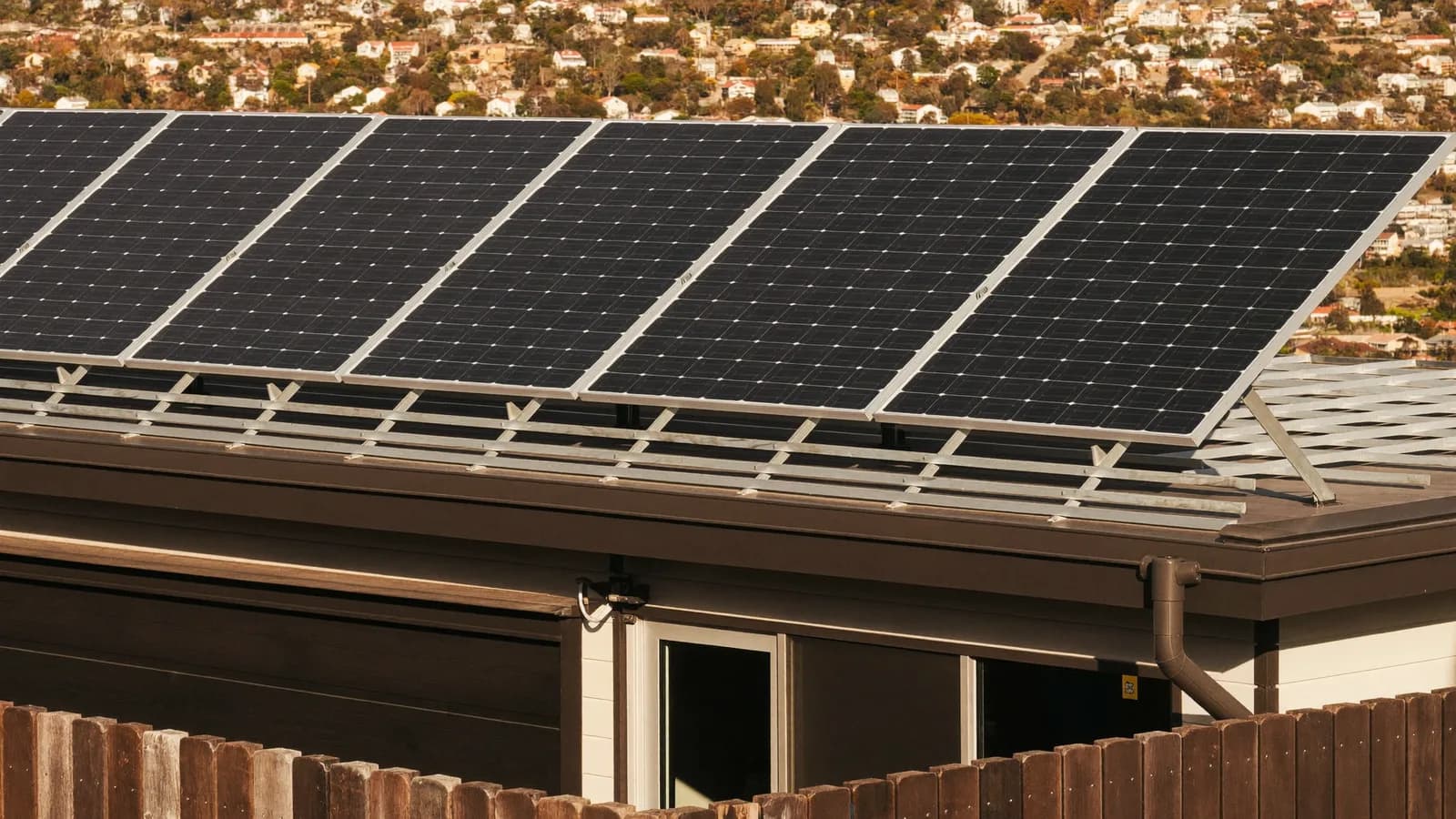
Flat roof solar is increasingly relevant for residential installations too, particularly for modern homes with skillion or flat roof designs, and for older homes with low-pitch roofs that cannot accommodate standard flush-mounted panel systems. For any flat or near-flat surface, a tilt frame mounting system is used to angle the panels correctly.
Ballasted vs Penetrating: The Two Mounting Approaches
| Feature | Ballasted | Penetrating |
|---|---|---|
| Held in place by | Weight (concrete/rubber ballast) | Bolts through roof into structure |
| Roof membrane risk | No penetrations (lower leak risk) | Penetrations sealed with flashing |
| Wind resistance | Good (depends on ballast weight) | Excellent (structurally anchored) |
| Roof load | Higher (ballast weight) | Lower (no ballast required) |
| Best for | Good membrane roofs, lower wind zones | High wind areas, lighter roof structures |
The choice between ballasted and penetrating mounts is ultimately an engineering decision based on your specific roof: its structure, membrane type, current load capacity, and the wind loading design requirements for your location. Your installer should provide a structural engineering assessment for any flat roof commercial installation. For residential flat roofs, an experienced installer will assess the roof and recommend the appropriate mounting system.
North-Facing vs East-West Arrays
A flat roof offers a choice that pitched roofs do not: you can orient the tilt frames in any direction. Two common strategies are north-facing arrays and east-west split arrays.
A north-facing array tilted at 20 to 35 degrees maximises total annual energy generation. It captures the most sun over the course of the year and is the right choice when feed-in tariff income or total generation matters most. The drawback is that inter-row spacing must be sufficient to prevent rows of panels from shading each other in winter when the sun is low, which limits how many panels can fit on a given roof area.
An east-west split array places panels on tilt frames facing both east and west at a shallower angle (typically 10 to 15 degrees). This generates slightly less total annual energy than a north-facing array of the same capacity, but it spreads generation more evenly across the day (the east panels produce strongly in the morning, the west panels in the afternoon), requires shallower tilt and therefore less inter-row spacing (fitting more panels on the roof), and reduces peak midday export to the grid. For commercial buildings with consistent daytime loads, east-west arrays often deliver better financial returns than north-facing despite slightly lower total generation.
Drainage and Panel Soiling
Adequate drainage is a critical design consideration for flat roof solar. Panels should be tilted enough (at least 10 degrees) to allow rain to wash the panel surface and ensure water drains away from below the mounting frames. Systems mounted too flat can trap water and debris under the panels, increasing soiling (dust and grime on the panel surface that reduces output), creating environments for pests, and potentially damaging the roof membrane over time through ponding.
Ask your installer to describe the drainage plan for your specific roof. The mounting system should direct water flow away from electrical connections and allow visual access for periodic inspection.
Commercial Flat Roof Solar: Additional Requirements
For commercial flat roof installations, several additional requirements apply. The structural engineering certificate is typically required for systems above a certain size or on older buildings where roof load capacity is not self-evident. Network connection approval from the local distribution network operator (DNSP) is required for grid-connected systems above 5kW single-phase. A licensed electrician and CEC-accredited designer must be involved for any system claiming the STC rebate.
For businesses, the Instant Asset Write-Off provisions may allow the full cost of a flat roof solar system to be deducted in the year of installation, subject to the relevant threshold and business eligibility. This significantly improves the first-year net cost and accelerates payback.
The next step
If you're considering solar panels or batteries for your home, Andy and the team can match you with one Why Solar Approved installer near you for a free written quote, and fifteen minutes with a solar expert before you sign.

Written by
Solar Installer Partner Relations
Connects homeowners with trusted, vetted solar installers across Australia. Andy works directly with installation companies to ensure quality standards and helps homeowners through the quoting process.
If you have any questions about the information in this guide, email andy@whysolar.com.au or call +61 2 5657 6527.