
Commercial Solar
Farm Solar Panels Australia: A Practical Guide for Farmers
Farms chew through electricity. Between irrigation pumps, milking machines, cold rooms, and shearing sheds, power bills can run into tens of thousands a year. Here is how solar can change that.
Get a free commercial solar quote
10 min read
See if your business is solar-ready
In short
Australian farms are some of the best candidates for solar in the country. Large shed roofs, high daytime power use, and access to the instant asset write-off mean most farm solar systems pay for themselves in 3 to 5 years. A typical dairy farm saves $10,000 to $25,000 per year on electricity with a 30 to 50kW system.
I work with solar installers across regional Australia, and I can tell you this: farms are where solar makes the most sense. Not suburbia. Not city offices. Farms.
The reasons are straightforward. You have massive roof areas on sheds that are doing nothing except keeping rain off machinery. You use the bulk of your power during daylight hours when the sun is producing. And your bills are big enough that the savings make a real difference to the farm's profit.
This guide covers everything you need to know about putting solar on your farm: what size system you need, whether to go roof-mount or ground-mount, how to handle irrigation pumps, what it costs, and how to squeeze every dollar out of the tax benefits. If you are looking at the broader commercial solar picture, we have a separate guide for that, but this one is written specifically for farmers.
And if you are a small business owner rather than a farmer, our solar panels for business guide covers the fundamentals of commercial solar economics.
Why farms are ideal for solar
Most residential solar systems are limited by roof space. A typical suburban house fits a 6.6kW system and the owners need to think carefully about panel placement and shading from neighbours' trees.
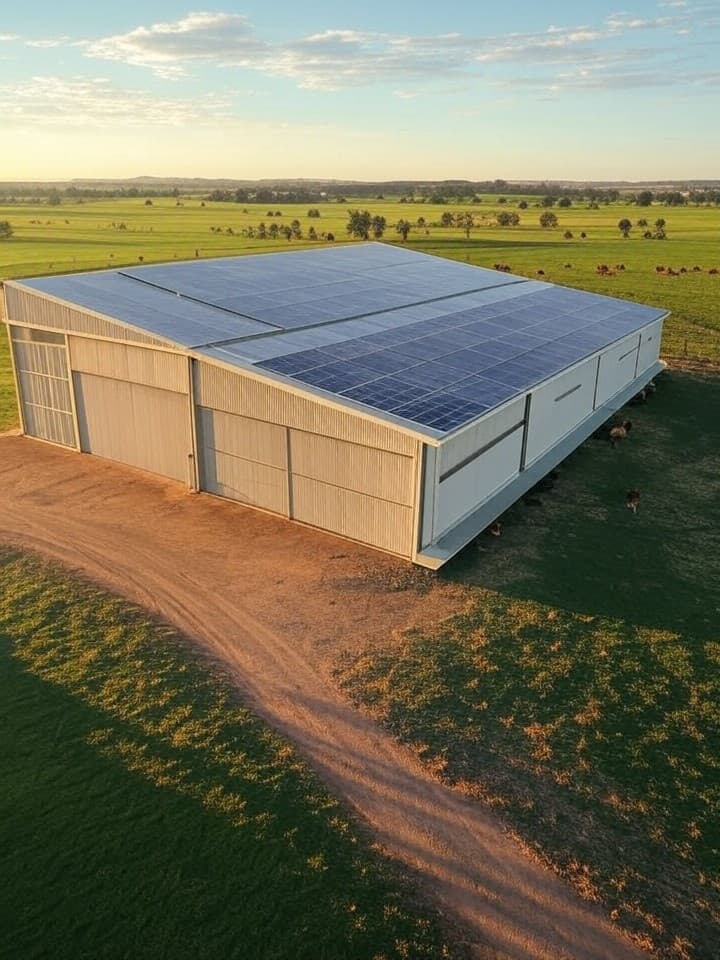
Farms have none of those problems. A standard machinery shed has 200 to 400 square metres of unshaded north-facing roof. That is enough for 40 to 80kW of panels without touching any other building. Add the dairy, the hay shed, and the workshop, and you could easily fit 100kW or more across the property.
The other advantage is load profile. Dairy farms run milking machines, vacuum pumps, and refrigeration compressors from early morning through the afternoon. Irrigation pumps run during the day. Shearing sheds, grain dryers, and cold storage all pull heavy loads during peak solar hours. This means most of the solar power you generate gets consumed on site rather than exported to the grid at a low feed-in tariff.
Self-consumption is where the real savings are. Every kilowatt-hour you use from your panels saves you 30 to 45c on your bill, compared to the 5 to 10c you would get by exporting it. On a farm, it is not unusual to self-consume 70 to 85% of generation, which is far higher than the 30 to 40% typical for a residential system.
See if your business is solar-ready
Free assessment, no obligation.
What size system does your farm need?
There is no one-size-fits-all answer, but here are some ballpark figures based on what I see installers quoting across different farm types.
| Farm type | Typical system size | Main loads | Annual savings |
|---|---|---|---|
| Dairy | 30 to 50kW | Milking machines, refrigeration, hot water | $10,000 to $25,000 |
| Broadacre cropping | 10 to 30kW | Irrigation pumps, grain handling, sheds | $4,000 to $12,000 |
| Feedlot / intensive livestock | 30 to 100kW | Feed mills, water pumps, cold storage | $12,000 to $40,000 |
| Vineyard / orchard | 15 to 40kW | Irrigation, cold storage, processing | $6,000 to $16,000 |
| Poultry | 30 to 80kW | Ventilation, lighting, feed systems | $10,000 to $30,000 |
The right approach is to look at your last 12 months of electricity bills and work backwards. Your installer should do a load analysis to match the system to your actual consumption patterns, not just slap panels on the roof. For a detailed look at commercial system pricing, see our commercial solar cost guide.
Ground-mounted vs roof-mounted: which is better?
On a farm, you have a genuine choice. Most suburban homes only have the roof, but farmers often have spare paddock area and plenty of shed roof space.
Roof-mounted panels are the cheaper option. You are using existing structure, so the racking costs are lower and the install is quicker. If your shed roof faces north (or even north-west) and is in decent condition, this is usually where to start. The main thing to check is the structural integrity of the shed. Older farm sheds were not always engineered for the extra load, so you may need a structural assessment.
Ground-mounted arrays cost roughly 10 to 20% more than an equivalent roof system because you are building the mounting structure from scratch. But they come with advantages. You can orient them perfectly north at the ideal tilt angle. You can place them close to the meter board or the loads they are feeding. Maintenance is easier because you are not climbing onto a roof. And if you need to expand later, you just extend the array.
Many farmers I work with start with roof panels on the main shed to keep costs down, then add a ground-mount array a year or two later when they have seen the savings and want more capacity.
Solar for irrigation pumps and bore water
Irrigation is one of the biggest electricity costs on many Australian farms, and it is also one of the best applications for solar. Pumps run during the day, they draw a consistent load, and in many cases the pump site is far from the grid connection.
There are two approaches. If the pump is near your main meter, you can power it from a standard grid-connected solar system along with everything else on the property. Simple.
For remote bore pumps in a far paddock, a standalone solar pumping system is often the better option. These use a dedicated solar array (typically 5 to 15kW for a bore pump) connected to a variable frequency drive (VFD) that runs the pump at variable speed depending on how much sun is available. No battery needed. The pump runs whenever there is enough sun, filling a header tank or storage dam. The water storage acts as your "battery". This setup avoids the cost of trenching power lines across the property, which can run $20 to $50 per metre over long distances.
A solar bore pump system with a 10kW array and VFD controller typically costs $15,000 to $25,000 installed. Compare that to running three-phase power 500 metres across a paddock at $30 per metre ($15,000 just for the trenching) plus the ongoing electricity costs, and solar starts looking very attractive.
Off-grid vs grid-connected for remote properties
Most farms that have existing grid connections should stay grid-connected. Going fully off-grid means adding a large battery bank and backup generator, which pushes costs up significantly. If you already have the grid, use it as your backup and battery in one.
Off-grid makes sense in two situations: when you are setting up a new property that has no grid connection (and the cost of getting one quoted at $50,000 or more), or when you are on a long, unreliable single-wire earth return (SWER) line that drops out regularly.
A full off-grid system for a farmhouse and basic shed loads typically needs 15 to 20kW of solar, 40 to 60kWh of battery storage, and a backup diesel generator. Total cost is in the $80,000 to $120,000 range. That is steep, but compare it to a $150,000 grid connection quote for a remote block, and it can make sense. If you are weighing up whether a battery is worth it, the maths changes quite a bit when you are off-grid, because the battery is not optional.
Costs and rebates for farm solar
Farm solar systems benefit from economies of scale. The bigger the system, the lower the per-watt cost. While a residential 6.6kW system might cost $1.30 to $1.60 per watt, a 50kW farm system typically comes in at $1.00 to $1.30 per watt, and 100kW systems can be under $1.00 per watt.
The federal Small-scale Technology Certificate (STC) rebate applies to systems up to 100kW, and to systems up to 1MW from 1 October 2026, which matters if you have the shed roof for it. For a 50kW system in, say, regional Queensland, the STC discount is roughly $13,110 to $14,592, which comes off the price at point of sale. Some states have additional programs for agricultural businesses. Check our commercial solar rebates guide for the latest state-by-state breakdown.
Here is a rough cost guide for farm systems after STC rebates.
| System size | Approx. cost (after STCs) | After instant asset write-off (37% bracket) |
|---|---|---|
| 20kW | $18,000 to $24,000 | $11,300 to $15,100 |
| 30kW | $25,000 to $34,000 | $15,750 to $21,400 |
| 50kW | $38,000 to $55,000 | $23,900 to $34,600 |
| 100kW | $80,000 to $120,000 | $50,400 to $75,600 |
See what your business can claim on solar
Based on your power bill and your business address.
Tax benefits: the instant asset write-off
This is where farm solar gets really interesting. Under the instant asset write-off, eligible businesses can deduct the full cost of the solar system in the financial year it is installed. For a farming business, that means the net cost after the tax deduction is substantially lower than the sticker price.
Say you install a 50kW system for $45,000 after STCs. If your farming business is in the 37% marginal tax bracket, you claim $16,650 back through the write-off. Your real out-of-pocket cost is $28,350 for a system that saves you $15,000 or more per year. That is under a two-year payback.
Timing matters. If you install before 30 June, you can claim the deduction in the current financial year. Plenty of farmers I talk to push to get their system commissioned before end of financial year specifically for this reason. Talk to your accountant about how the write-off interacts with farm management deposits and other primary producer concessions.
For larger systems that exceed the write-off threshold, the ATO depreciation rules let you claim the cost over the system's effective life. The simplified depreciation pool (15% year one, 30% thereafter) is usually the best option for small farming businesses.
Three real-world farm solar scenarios
Dairy farm, Gippsland VIC
A 300-cow dairy running two milkings per day with vat refrigeration and electric hot water. Electricity bill was $28,000 per year. Installed 40kW of panels across the dairy roof and machinery shed.
System cost: $38,000 after STCs. After the instant asset write-off, the effective cost was $24,000. The system generates around 52,000 kWh per year with 78% self-consumption, saving approximately $16,000 annually. Payback: 18 months on the effective cost.
Broadacre cropper, Moree NSW
A mixed cropping operation with centre-pivot irrigation, grain augers, and a workshop. Power bill was $14,000 per year, mostly from irrigation during summer. Installed 20kW on the main shed roof plus a standalone 10kW solar pump system for a bore 800 metres from the homestead.
Grid-connected system cost: $22,000 after STCs. Solar pump system: $18,000. Total: $40,000 before tax write-off, $25,200 after. Combined savings of approximately $12,000 per year from reduced grid consumption and eliminated bore pump running costs. Payback: just over two years.
Vineyard, Barossa Valley SA
A 50-hectare vineyard with drip irrigation, cold storage for harvest, and a cellar door with air conditioning. Electricity bill was $18,000 per year with heavy summer usage. Installed 25kW across the winery roof and packing shed.
System cost: $26,000 after STCs. After the write-off, effective cost was $16,400. Annual savings of $11,000 with excellent self-consumption because the cooling and irrigation loads align perfectly with peak solar generation. Payback: 18 months on the effective cost. South Australia's high electricity prices make the numbers particularly strong.
Finding the right installer for farm solar
Farm solar is not the same as residential solar. You need an installer who understands three-phase systems, commercial-scale inverters, agricultural load profiles, and the practicalities of working on rural properties (like getting a crane to a shed in the middle of a paddock).
Look for installers with specific experience in agricultural solar, not just a residential company trying to move into the commercial space. Ask to see examples of farm installs they have completed. A good installer will do a proper site assessment, review at least 12 months of power bills, and size the system to match your actual usage, not just fill every available roof.
Make sure you vet the installer thoroughly. Our guide on how to vet a solar installer walks through exactly what to check. For commercial-scale systems, also make sure the installer handles the network application process, as systems over 30kW often require approval from your distribution network.
Common questions about farm solar panels
How much do farm solar panels cost in Australia?expand_more
Farm solar systems typically cost $1.00 to $1.40 per watt installed for systems over 30kW, before rebates. A 30kW system runs around $28,000 to $38,000, while a 100kW system costs $90,000 to $130,000. STCs and state rebates can reduce costs by 20 to 30%, and the instant asset write-off means you can claim the full cost as a tax deduction in the year of purchase.
Can solar panels run irrigation pumps?expand_more
Yes. Solar can power irrigation pumps directly using a solar pump controller, or through a standard grid-connected system. For bore pumps in remote paddocks, standalone solar pump systems with a variable frequency drive are popular because they avoid the cost of running grid power to the pump site. These systems run the pump whenever the sun shines, filling a header tank or dam.
Is ground-mounted or roof-mounted solar better for farms?expand_more
Both work well. Roof-mounted is cheaper because the structure already exists. Ground-mounted costs 10 to 20% more but lets you angle panels optimally and place them in the ideal location. Most farmers start with shed roofs and add ground-mount later if they need more capacity.
Can farmers claim the instant asset write-off on solar?expand_more
Yes. Under the current instant asset write-off, eligible businesses with aggregated turnover under $10 million can deduct the full cost of a solar system in the financial year it is installed. For a farmer in the 37% tax bracket installing a $40,000 system, that is $14,800 back in tax, bringing the real cost down to $25,200.
What size solar system does a farm need?expand_more
It depends on the operation. Dairy farms typically need 30 to 50kW. Broadacre cropping suits 10 to 30kW. Feedlots and intensive livestock operations may need 50 to 100kW or more. Your installer should size the system based on your actual electricity bills and usage patterns, not just available roof space.
The next step
If you're considering commercial solar for your business, Andy and the team can match you with one vetted commercial installer for a free written quote.

Written by
Solar Installer Partner Relations
Connects homeowners with trusted, vetted solar installers across Australia. Andy works directly with installation companies to ensure quality standards and helps homeowners through the quoting process.
If you have any questions about the information in this guide, email andy@whysolar.com.au or call +61 2 5657 6527.