Solar Panel Bird Proofing Australia | $350-$700 to Save Thousands
Your solar rebate, checked before you sign
8 min read
Find out what your home actually needs
Bird nesting under solar panels cuts output by 20 to 30%, voids warranties, and causes thousands in damage. Professional bird mesh costs $350 to $700 for a standard home ($18 to $30 per metre). Best done at install time. DIY kits ($150 to $250) exist but professional fitting ensures warranty compliance.
Nobody thinks about birds when they're getting solar installed. You're busy comparing panel specs, checking rebate eligibility, and getting quotes from installers. Birds are about the last thing on your mind.
Then six months later you hear scratching on the roof at 5am. You look up from the backyard and there's straw poking out from under your panels. Droppings streaking down the glass. And when you get someone up there to take a look... it's not great.
Bird damage is one of those problems that starts small and gets expensive fast. The good news is it's completely preventable. And cheap to fix compared to what happens if you ignore it.
Why birds treat your panels like a five-star hotel
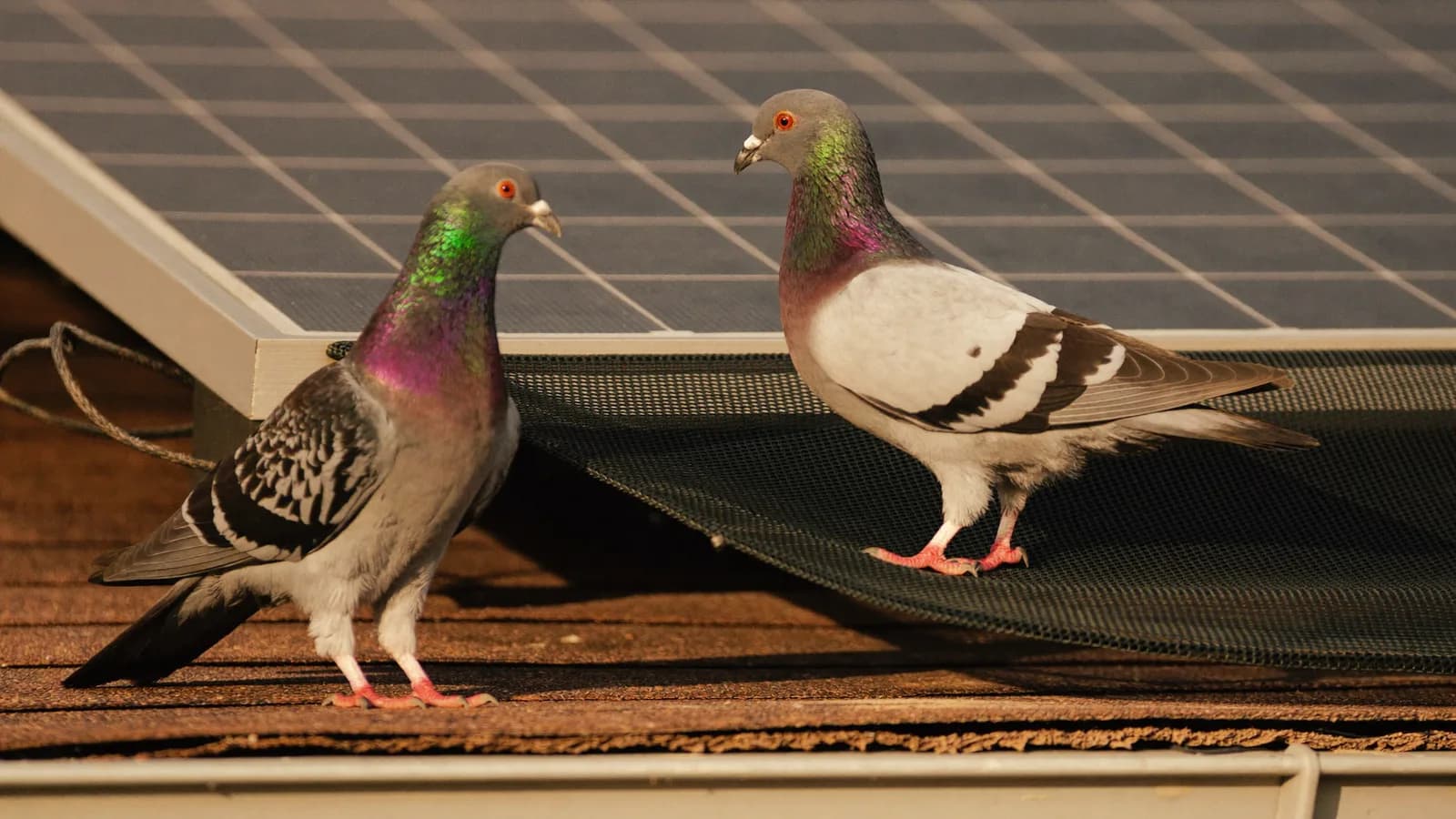
Think about it from a pigeon's perspective. Your solar panels create this perfect sheltered gap between the panel and the roof. It's warm (panels radiate heat underneath), it's dry, it's protected from predators, and there's a nice flat surface to build a nest on. It's basically a free Airbnb with heating.
In Australia, the usual suspects are pigeons, mynas, starlings, and noisy miners. Pigeons are the worst offenders because they're persistent nesters. They'll keep coming back to the same spot year after year, building on top of old nests until you've got a solid mat of straw, feathers, and droppings packed under your panels.
And here's where it stops being a minor annoyance and starts costing you money.
Find out what your home actually needs
Free, takes 60 seconds, no obligation.
The damage nobody warns you about
Bird droppings aren't just ugly. They're acidic. When droppings sit on your panels, they create hot spots (sections of the panel that heat unevenly), which degrades the cells and permanently reduces output. A solid splatter of pigeon mess can cut that panel's output by 20-30%. Across a whole array with droppings building up over months... you're losing real money on every power bill. (Our panel cleaning guide covers how to safely remove droppings without damaging your panels.)
But it goes deeper than the panels themselves.
Chewed wiring. Birds peck at exposed cables and connectors. A severed DC cable isn't just a performance issue, it's a fire risk.
Roof corrosion. Acidic droppings and moisture trapped under nests eat into Colorbond and metal roofing. Rust forms around mounting brackets, compromising the entire structure.
Blocked drainage. Nesting material washes into gutters. Water backs up, overflows, and can cause internal water damage to your home.
Health hazards. Pigeon droppings carry 60+ pathogens. Bird mites migrate inside through roof spaces. Not something you want near your family.
Voided warranty. Panel and inverter warranties don't cover damage from birds, nesting, or corrosion caused by droppings. You're on your own.
The frustrating part is that a $4,000-$12,000 solar investment can be undermined by a $500 problem that nobody thought to mention at install time.
The fix: PVC-coated wire mesh (and why nothing else comes close)
People try four main approaches. Only one of them actually works long-term.
Wire mesh barrier
✓ Recommended
PVC-coated stainless steel mesh clipped around the full perimeter of your panels. Creates a physical barrier with no gaps. Birds physically cannot get in. Period.
Effectiveness: 10/10 • Longevity: 10+ years
Bird spikes
Stop birds perching on panel edges but don't seal the gap underneath. Persistent pigeons just find another way in. A bandaid, not a fix.
Effectiveness: 4/10 • Doesn't seal gaps
Ultrasonic deterrents
Solar-powered devices that emit high-frequency sounds. Works initially but birds habituate within weeks. They figure out it's all bark and no bite.
Effectiveness: 3/10 • Birds adapt quickly
Optical gels
Multi-sensory gel dishes that create discomfort for birds. Need replacing every 2-3 years, weather degrades them, and they don't physically block access.
Effectiveness: 5/10 • Requires maintenance
Mesh is the only method that creates a genuine physical barrier. Everything else either wears off, breaks down, or the birds outsmart it. If you're going to do it, do it once and do it right.
How mesh installation actually works
The process is straightforward. A decent installer will knock it out in 2-3 hours for a standard residential system. Here's what happens:
- Clean underneath. High-pressure wash under the panels to remove all existing nests, droppings, and debris. This is critical. You don't want to seal birds or nests inside.
- Measure and cut. Measure the full perimeter of the array and cut PVC-coated stainless steel mesh to size, allowing extra for bends at corners and overlaps at joins.
- Clip to panel frames. The mesh attaches to the panel frames using specialised clips (Vexo clips are the industry standard). No drilling, no adhesive, no damage to panels. This is key: drilling into frames voids your warranty.
- Tension and seal. The mesh is tensioned tight to the roofline so there's no gap for birds to squeeze through. Corners and joins are overlapped and secured with UV-rated zip ties.
Important: use a licensed electrician
Bird proofing is a modification to an existing electrical structure. Using someone who isn't electrically licensed can void your solar warranty entirely. Always check that whoever does the work holds the right credentials.
What it costs (and why it's a no-brainer)
Professional bird proofing for a standard residential solar system in Australia typically runs between $350 and $700. For larger systems or steep roofs, it can push towards $1,000-$1,500.
Now compare that to the alternative. A panel replacement from hot spot damage runs $300-500 per panel. Roof repairs from corrosion can hit $2,000+. A full re-wire of chewed DC cables is $500-$1,000. And that's before you factor in the output you've been losing on every power bill while the birds were doing their thing.
Spending $500 now to avoid $3,000-$5,000 later isn't even a decision. It's maths.
Your rebate, worked out to your address
Then one Why Solar Approved installer near you, and fifteen minutes with a solar expert before you sign.
Can you DIY it?
Technically, yes. A 30-metre mesh kit with clips costs around $150-$250 from places like Pestrol, Bird Control Australia, or Aussie DIY Solutions. If you're comfortable working on a roof and have tin snips, pliers, and some patience... it's doable.
But there are a few reasons to think twice.
First, you're working at height around an electrical system. One slip, one wrong move near DC cabling, and you've got a problem that's a lot more serious than pigeons.
Second, if the mesh isn't installed properly (gaps at corners, loose clips, mesh not tensioned to the roofline), the birds will find their way in. You'll have wasted the money and the Saturday afternoon.
Third, quality matters more than you'd think. Cheap galvanised mesh from Bunnings will rust and fall apart within a couple of years on a hot roof. Then you're up there again doing it all over. Spend the extra on PVC-coated stainless steel. It's rated for 10+ years in Australian conditions.
If you're going to DIY it, at least make sure any existing nests and droppings are cleared out first. Sealing birds inside is cruel and illegal under Australian wildlife protection laws.
The best time to bird proof your panels
The absolute best time is when your panels are being installed. It's cheaper (the installer is already on the roof with the right gear), it's faster, and you never give the birds a chance to move in.
If you're getting quotes for a new solar system (see our guide on how to choose solar panels), ask every installer what they charge to add bird mesh at the same time. Some include it in the price, some charge a small add-on. Either way, it'll be less than getting someone out later.
The second-best time is right now, before nesting season kicks off. In most of Australia, pigeons breed year-round but peak between September and March. Getting mesh installed before spring means you're ahead of the rush and ahead of the birds.
If birds have already set up shop, a professional can humanely remove the nests and any chicks before installing the mesh. Baby birds are relocated to wildlife carers. It's all done within the rules.
What to look for in a bird proofing installer
Ask your solar installer first. Many now offer bird proofing as an add-on service, and they already know your system inside out. Our guide on how to vet a solar installer covers how to check credentials. If they don't offer it, a specialist solar bird proofing company is the next best option, just make sure they tick the boxes above.
Don't let a $500 problem turn into a $5,000 one
Bird proofing isn't glamorous. Nobody puts it on their Instagram. But it's one of those boring, practical things that quietly saves you a fortune over the life of your system. If you are still getting your head around how solar works, bird proofing is one of those details worth knowing about early.
PVC-coated stainless steel mesh, clipped to the frames, tensioned to the roofline, installed by someone who knows what they're doing. That's the whole solution: one afternoon, one invoice, and you never think about it again.
Your panels keep producing, your roof stays intact, and the pigeons find somewhere else to live.
The next step
If you're considering solar panels or batteries for your home, Andy and the team can match you with one Why Solar Approved installer near you for a free written quote, and fifteen minutes with a solar expert before you sign.

Written by
Solar Installer Partner Relations
Connects homeowners with trusted, vetted solar installers across Australia. Andy works directly with installation companies to ensure quality standards and helps homeowners through the quoting process.
If you have any questions about the information in this guide, email andy@whysolar.com.au or call +61 2 5657 6527.