
Solar Guides
How to Choose the Right Solar Panels for Your Home
With dozens of brands and hundreds of models available in Australia, choosing the right solar panels can feel overwhelming. Here's everything you need to know to make a confident decision.
Your solar rebate, checked before you sign
8 min read
Find out what your home actually needs
In short
Choose monocrystalline panels (20 to 22% efficiency) from a Tier 1 manufacturer with a 25-year product warranty. For most Australian homes, a 6.6kW system with 15 to 18 panels is the sweet spot. The inverter quality and installer reputation matter as much as the panels themselves.
If you are still deciding whether to go solar at all, our breakdown of whether solar is worth it in 2026 covers the financial case. But if you have already made that call, the next question is which panels to pick. Walking into the world of solar panels can feel like walking into an electronics store in the 90s. Every salesperson has a different opinion. Every brand claims to be the best. And the spec sheets might as well be written in a foreign language.
But here's the good news: choosing solar panels doesn't have to be complicated. Once you understand a few key concepts, you'll be able to cut through the marketing noise and focus on what actually matters for your home and budget.
Let's break it down.
Monocrystalline vs polycrystalline: Does it still matter?
You'll often see panels described as "monocrystalline" or "polycrystalline." Here's the quick version: monocrystalline panels are made from a single silicon crystal, while polycrystalline panels are made from multiple crystals melted together.
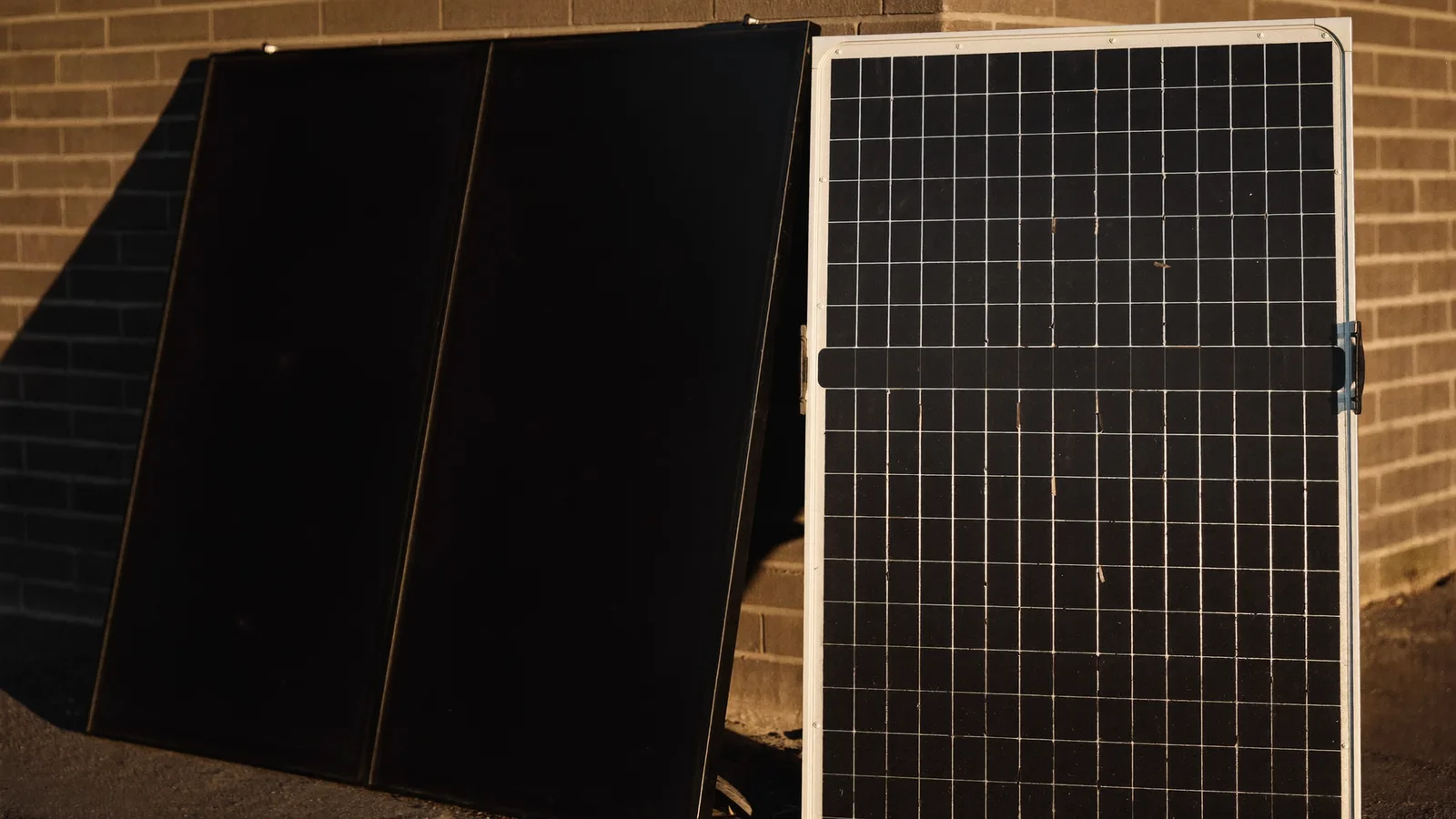
In practice, monocrystalline panels are more efficient (they convert more sunlight into electricity) and perform slightly better in low-light conditions. They're also typically black in colour, which many homeowners prefer aesthetically.
Polycrystalline panels are usually blue-ish and slightly less efficient, but they used to be cheaper. The key word there is "used to be."
Here's the thing: in 2026, the price difference has essentially disappeared. Manufacturing improvements mean monocrystalline panels are now just as affordable as poly, with better performance. As a result, almost every quality panel on the Australian market today is monocrystalline.
If an installer quotes you polycrystalline panels, ask why. There might be a legitimate reason, but in most cases, you should be getting mono.
Understanding efficiency ratings (and why they matter less than you think)
Panel efficiency is the percentage of sunlight that gets converted into electricity. A 22% efficient panel converts 22% of the light hitting it into usable power.
Premium panels from brands like SunPower and REC sit around 22-23% efficiency. Mid-range panels from Jinko, Trina, and Canadian Solar typically hit 20-21%. Budget panels might be 18-19%.
Here's where people get confused: higher efficiency doesn't necessarily mean better value.
Efficiency matters most when you have limited roof space. If you can only fit 10 panels, then yes, getting the most efficient panels makes sense because you need to maximise every square metre.
But if you've got plenty of roof space? A 21% efficient system and a 19% efficient system will produce roughly the same amount of power. You'll just need a couple more panels with the less efficient option. And those extra panels often cost less than the premium for high-efficiency models.
The real question to ask
Instead of "What's the most efficient panel?", ask "How much power will this system produce annually, and what will it cost per kWh of generation over 25 years?" That's the metric that actually affects your wallet. Our solar basics guide explains how generation, self-consumption, and feed-in tariffs all fit together.
Find out what your home actually needs
Free, takes 60 seconds, no obligation.
Product warranty vs performance warranty: Know the difference
Every solar panel comes with two types of warranties, and they cover very different things.
Product warranty (also called manufacturing warranty) covers defects in materials and workmanship. If your panel cracks, delaminates, or fails due to a manufacturing issue, this warranty covers replacement. Most quality panels offer 12-15 years, with premium brands offering 25 years.
Performance warranty guarantees the panel will still produce a certain percentage of its rated output after a set number of years. Standard is 80-84% output after 25 years. Some premium panels guarantee 92% output after 25 years.
Here's what many people miss: a warranty is only as good as the company backing it.
A 25-year warranty from a manufacturer that might not exist in 5 years is worthless. A 15-year warranty from a company with a strong Australian presence, local stock, and a track record of honouring claims is far more valuable.
Strong warranty signs
- Australian warehouse and support team
- Clear claim process documented online
- Company trading for 10+ years
- Covers labour costs for replacement
Warranty red flags
- Claims must go through overseas HQ
- No Australian office or stock
- Brand is less than 5 years old
- Warranty excludes labour costs
What "Tier 1" actually means (and doesn't mean)
You'll hear salespeople throw around "Tier 1 panels" like it's a quality certification. It's not.
The Tier 1 classification comes from Bloomberg New Energy Finance (BNEF) and it measures one thing: bankability. Essentially, it asks whether banks and financiers are willing to fund large-scale solar projects using panels from that manufacturer.
Being Tier 1 means the company is financially stable, has been around for a while, and produces panels at scale. It's a decent indicator of reliability, but it doesn't directly measure panel quality or performance.
A Tier 1 manufacturer can still make budget panels alongside their premium range. And some excellent smaller manufacturers might not meet the bankability criteria simply because they don't operate at massive scale.
Tier 1 is a good baseline filter, but don't use it as your only criteria. A Tier 1 panel from a company with poor Australian support is still a risky choice.
Trusted brands in Australia
Brands like Jinko, Trina, Canadian Solar, LONGi, QCells, REC, and SunPower have strong Australian presence and track records. Check out our best solar panels in Australia ranking for detailed breakdowns.
Your rebate, worked out to your address
Then one Why Solar Approved installer near you, and fifteen minutes with a solar expert before you sign.
Solar panel brand comparison
Here is a quick reference comparing the most common panel brands you will see on Australian quotes. All are Tier 1 manufacturers with CEC approval and local support.
| Brand | Origin | Tier | Efficiency | Product Warranty | Best For |
|---|---|---|---|---|---|
| LONGi | China | Tier 1 | 20.5 to 22.8% | 12 to 25 years | Great value, world's largest panel maker |
| Jinko | China | Tier 1 | 20.5 to 22.5% | 12 to 25 years | Strong Australian presence, reliable mid-range |
| Trina | China | Tier 1 | 20.5 to 22.5% | 15 to 25 years | Well-proven, popular with installers |
| Canadian Solar | Canada / China | Tier 1 | 20.5 to 22.3% | 12 to 25 years | Solid all-rounder, good local support |
| REC | Norway / Singapore | Tier 1 | 21.0 to 22.6% | 25 years | Premium quality, excellent warranty |
| SunPower / Maxeon | USA / Singapore | Tier 1 | 22.0 to 22.8% | 25 to 40 years | Highest efficiency, limited roof space |
What to look for when comparing quotes
A quality installer will provide a detailed, itemised quote. But if you don't know what to look for, you're just looking at numbers without context. Our guide to reading solar quotes walks through every line item you should check.
Here's what actually matters when you're comparing solar quotes:
Total system size (kW)
Not just panel count. A 6.6kW system with 15 x 440W panels is different from 6.6kW with 20 x 330W panels.
Panel brand AND specific model
Jinko makes budget and premium panels. "Jinko panels" tells you nothing. Get the exact model number.
Inverter brand, model, and size
The inverter is just as important as the panels. A cheap inverter will undermine quality panels.
Estimated annual production (kWh)
This should account for your roof orientation, shading, and location. Ask how they calculated it.
Warranty details for panels AND inverter
Get the actual warranty documents, not just verbal promises.
What is included in the price
Meter upgrade? Switchboard work? WiFi monitoring? Roof reinforcement? Get it in writing.
A good installer will provide all this information upfront. If you have to chase them for basic details, that tells you something about how they'll handle issues after installation. Our guide on how to vet a solar installer covers the due diligence steps in detail.
Red flags to avoid
The solar industry in Australia is mostly full of good operators, but there are still some practices to watch out for.
Pressure to sign today
Legitimate offers do not expire in 24 hours. If they are pushing urgency, they are worried you will compare prices.
Unusually low prices
If one quote is 40% cheaper than others, something is missing. Budget panels, undersized inverter, or corners being cut on installation.
No site visit before quoting
Accurate quotes require seeing your roof, switchboard, and meter. Google Earth is not enough.
Vague about the installer
Ask who will actually install the system. If they cannot tell you, they might be subcontracting to whoever is available.
Claiming massive rebates that others are not
The federal STC rebate is the same for everyone and reduces each year until 2030. State rebates have fixed values. If one company claims a $5,000 rebate others do not mention, dig deeper.
No CEC accreditation
The Clean Energy Council accredits installers. No accreditation means no rebate eligibility and potentially unsafe work.
Making your decision
At the end of the day, the "best" solar panel is the one that fits your specific situation: your budget, your roof space, your energy needs, and your risk tolerance.
For most Australian homes, a mid-range system from a reputable brand with strong local support will deliver excellent results. Our solar panel cost guide breaks down exactly what you should expect to pay in 2026. You don't need the most expensive panels on the market, but going for the absolute cheapest option is rarely worth the long-term risk.
Focus on the total package: quality panels, a reliable inverter, professional installation, and an installer who'll be around to support you for years to come. Our inverter comparison and warranty comparison tool can help you evaluate the full picture.
Get that combination right, and you'll enjoy decades of clean, cheap electricity. Get it wrong, and you'll be dealing with headaches long after the salesperson has moved on.
Not sure where to start? Take our rebate eligibility quiz to see what incentives you qualify for, then get matched with vetted local installers who can give you proper quotes. And with STC rebates decreasing each year, acting sooner locks in a bigger discount. If you already have panels and want to expand, see our guide on adding panels to an existing system.
The next step
If you're considering solar panels or batteries for your home, Andy and the team can match you with one Why Solar Approved installer near you for a free written quote, and fifteen minutes with a solar expert before you sign.

Written by
Solar Installer Partner Relations
Connects homeowners with trusted, vetted solar installers across Australia. Andy works directly with installation companies to ensure quality standards and helps homeowners through the quoting process.
If you have any questions about the information in this guide, email andy@whysolar.com.au or call +61 2 5657 6527.